 ChipApex | Global Electronic Components Supplier
SEARCH
Search Product
Search Post
— IC芯片 | 连接器 | 传感器 | 被动器件 —
Search productSearch post
— IC芯片 | 连接器 | 传感器 | 被动器件 —
Consult the customer manager about the wholesale price.
consultation hotline:86-132-6715-2157
email:[email protected]
Contact the product manager for consultation. One-stop consultation is available.
Do you want a lower wholesale price? Please send us your inquiry and we will reply immediately.
The SN74GTLPH16945 is a 16-bit LVTTL-to-GTLP bus transceiver partitioned into two 8-bit segments. It operates at VCC of 3.15V to 3.45V with B-port outputs providing 50mA drive current and A-port outputs providing ±24mA. The device supports bidirectional data transfer between LVTTL logic levels and GTLP signal levels, featuring propagation delays ranging from 2.1ns to 6.9ns depending on direction and load conditions.
Verify the specific package variant (DGG TSSOP, DGV TVSOP, or GQL VFBGA) required for your design, as ordering suffixes determine the physical footprint. Confirm RoHS compliance status and moisture sensitivity level ratings before finalizing procurement orders. Ensure compatibility with existing PCB layout constraints regarding pin counts and thermal requirements.
Select this component when interfacing systems requiring translation between standard LVTTL voltage domains and the lower swing GTLP signaling standard. Consider the medium-drive output capability suitable for heavily loaded backplanes with equivalent load impedances down to 19 ohms. Evaluate the need for integrated overshoot protection and bus-hold features to simplify external component requirements.
This device belongs to the Texas Instruments Widebus family of logic components. It is designed specifically for the Gunning Transceiver Logic (GTL) JEDEC standard derivative known as GTLP. The architecture allows for efficient signal integrity management in complex multi-drop bus topologies common in server and networking hardware architectures.
SN74GTLPH16945GR
The device supports live insertion via Ioff, power-up 3-state, and BIASVCC circuits. These features disable outputs when powered down, place outputs in a high-impedance state during power cycles, and precharge B-port connections to prevent disturbance of active data on the backplane.
TI-OPC circuitry actively limits overshoot caused by improperly terminated backplanes, unevenly distributed cards, or empty slots during low-to-high signal transitions. This improves signal integrity and maintains adequate noise margins at higher frequencies.
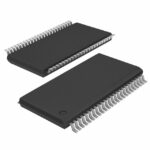 74GTLPH16945VRE4
The activity of extra discounts on wholesale prices is in full swing…
Please fill in your contact information and we will send you the latest wholesale price list.






