 ChipApex | Global Electronic Components Supplier
SEARCH
Search Product
Search Post
— IC芯片 | 连接器 | 传感器 | 被动器件 —
Search productSearch post
— IC芯片 | 连接器 | 传感器 | 被动器件 —
Consult the customer manager about the wholesale price.
consultation hotline:86-132-6715-2157
email:[email protected]
Contact the product manager for consultation. One-stop consultation is available.
Do you want a lower wholesale price? Please send us your inquiry and we will reply immediately.
The Nexperia 74HC123D-Q100,118 is a dual retriggerable monostable multivibrator with reset, housed in an SO16 plastic small outline package (SOT109-1). It operates within a supply voltage range of 2.0 V to 6.0 V and supports ambient temperatures from -40 °C to +125 °C. The device features Schmitt-trigger action on inputs nA and nB for noise immunity and includes clamp diodes for interfacing voltages exceeding VCC. Pulse width is programmed via external resistor REXT and capacitor CEXT, allowing extension through retriggering or immediate termination via the direct reset input nRD.
Verify that the specific ordering suffix matches the required package type, as the 74HC123 family utilizes multiple distinct packages including SO16, TSSOP16, and DHVQFN16. Confirm the temperature grade aligns with system requirements, noting that this specific part number is specified for operation up to +125 °C. Ensure design compatibility with the SO16 footprint defined by SOT109-1 before finalizing procurement orders.
Select this component when automotive-grade reliability is mandatory alongside wide operating temperature ranges. The HC series offers CMOS low power dissipation and high noise immunity suitable for mixed-signal environments. Verify that the external timing components can support the desired pulse width calculations based on the recommended operating conditions and static characteristics provided in the datasheet.
This device belongs to the Nexperia 74HC123-Q100 family of dual retriggerable monostable multivibrators. It is pin-compatible with Low-power Schottky TTL (LSTTL) devices and complies with JEDEC standards JESD8C and JESD7A. The product is designed for robust performance in demanding electronic environments, featuring latch-up protection exceeding 100 mA per JESD 78 Class II Level B specifications.
The 74HCT123D-Q100 serves as a functional alternative within the same family, differing primarily in input voltage levels which are compatible with TTL logic rather than standard CMOS levels.
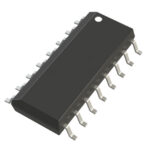 74HC123D-Q100,118
The activity of extra discounts on wholesale prices is in full swing…
Please fill in your contact information and we will send you the latest wholesale price list.






