 ChipApex | Global Electronic Components Supplier

SEARCH
Search Product
Search Post
— IC芯片 | 连接器 | 传感器 | 被动器件 —
Search productSearch post
— IC芯片 | 连接器 | 传感器 | 被动器件 —
Consult the customer manager about the wholesale price.
consultation hotline:86-132-6715-2157
email:[email protected]
Contact the product manager for consultation. One-stop consultation is available.
Do you want a lower wholesale price? Please send us your inquiry and we will reply immediately.
The 74HC14N,652 is a high-speed silicon-gate CMOS hex inverting Schmitt trigger manufactured by NXP Semiconductors. It operates within a supply voltage range of 2.0 V to 6.0 V and supports an ambient temperature range from -40 °C to +125 °C. The device features six independent inverting buffers with Schmitt-trigger action, transforming slowly changing input signals into sharply defined output signals. It provides ESD protection exceeding 2000 V (HBM) and 200 V (MM). The component is housed in a 14-lead plastic dual in-line package (DIP14, SOT27-1) designed for through-hole mounting.
Verify the specific ordering suffix '652' against current NXP documentation to confirm package type and temperature grade. Confirm RoHS compliance status as indicated in the latest product data sheet. Ensure the DIP14 package variant matches the intended PCB footprint requirements. Check for any recent lifecycle status updates regarding production availability.
Select this component when slow-rising input signals require noise immunity provided by Schmitt-trigger hysteresis. The HC logic family ensures compatibility with standard CMOS levels across a wide voltage range. Verify that the required operating temperature extends to +125 °C, as this specific part number covers the extended industrial range compared to standard commercial variants.
This component belongs to the 74HC/HCT logic family, which is pin-compatible with Low-power Schottky TTL (LSTTL). It is specified in compliance with JEDEC standard No. 7A. The 'HC' designation indicates high-speed CMOS technology, while the '14' functional code identifies it as a hex inverter with Schmitt triggers. The 'N' suffix denotes the PDIP package style.
Direct pin-compatible replacements include other manufacturers' 74HC14 devices in DIP-14 packages. Cross-reference with 74HCT14N if TTL-level input compatibility is required instead of CMOS levels. Verify that any substitute maintains the same extended temperature rating (-40 °C to +125 °C) and Schmitt-trigger characteristics.
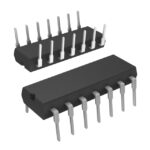 74HC14N,652

The activity of extra discounts on wholesale prices is in full swing…
Please fill in your contact information and we will send you the latest wholesale price list.





