 ChipApex | Global Electronic Components Supplier

SEARCH
Search Product
Search Post
— IC芯片 | 连接器 | 传感器 | 被动器件 —
Search productSearch post
— IC芯片 | 连接器 | 传感器 | 被动器件 —
Consult the customer manager about the wholesale price.
consultation hotline:86-132-6715-2157
email:[email protected]
Contact the product manager for consultation. One-stop consultation is available.
Do you want a lower wholesale price? Please send us your inquiry and we will reply immediately.
The Nexperia 74HC2G04GW-Q100H is a dual inverter integrated circuit designed for automotive applications, qualified to AEC-Q100 Grade 1 standards. It operates within a supply voltage range of 2.0 V to 6.0 V and supports an ambient temperature range from -40 °C to +125 °C. The device utilizes CMOS technology with balanced propagation delays and high noise immunity. It features inputs equipped with clamp diodes to facilitate interfacing with voltages exceeding the supply rail when current limiting resistors are used.
Verify that the specific ordering suffix matches the required package type, as the Q100H designation indicates automotive qualification but does not define the physical footprint. Confirm the exact part number against the manufacturer's official documentation to ensure compatibility with design constraints. Cross-reference the marking code H4 on the component body to validate authenticity and correct revision level before integration into production.
Select this component when automotive reliability under extended temperature conditions is mandatory. The HC logic family provides CMOS input levels suitable for standard digital interfaces. Ensure the application voltage remains within the 2.0 V to 6.0 V range to maintain specified performance characteristics. Consider the TSSOP6 package dimensions if board space is constrained, noting the specific lead pitch and body width requirements for PCB layout.
This device belongs to the Nexperia 74HC(H)T2G04-Q100 series of dual inverters. It shares functional similarities with other members of the 74HC2Gxx-Q100 family but is specifically configured for logical inversion operations. The GW suffix identifies the TSSOP6 plastic thin shrink small outline package variant, distinguishing it from surface-mounted TSOP6 options available in the same product line.
Direct substitutes include the 74HCT2G04GW-Q100H for TTL-compatible input levels or the 74HC2G04GV-Q100H for alternative SC-74 packaging. Verify pinout compatibility and electrical parameters such as propagation delay and output drive strength before swapping packages.
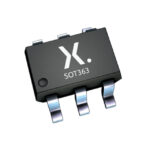 74HC2G04GW-Q100H

The activity of extra discounts on wholesale prices is in full swing…
Please fill in your contact information and we will send you the latest wholesale price list.




