 ChipApex | Global Electronic Components Supplier

SEARCH
Search Product
Search Post
— IC芯片 | 连接器 | 传感器 | 被动器件 —
Search productSearch post
— IC芯片 | 连接器 | 传感器 | 被动器件 —
Consult the customer manager about the wholesale price.
consultation hotline:86-132-6715-2157
email:[email protected]
Contact the product manager for consultation. One-stop consultation is available.
Do you want a lower wholesale price? Please send us your inquiry and we will reply immediately.
The Nexperia 74HC2GU04GW-Q100H is a dual unbuffered inverter qualified to AEC-Q100 Grade 1 standards. It operates within a supply voltage range of 2.0 V to 6.0 V and supports ambient temperatures from -40 °C to +125 °C. The device features inputs with clamp diodes for interfacing voltages exceeding VCC. Propagation delay ranges from 10 ns to 90 ns depending on voltage and temperature, while transition time spans 13 ns to 125 ns. Static characteristics include an input leakage current of ±1.0 μA maximum at 6.0 V and a supply current up to 20.0 μA.
Verify the specific package variant required, as the GW suffix denotes TSSOP6 (SOT363-2). Confirm that the selected component meets the intended thermal environment requirements, specifically the extended temperature range up to +125 °C. Ensure design safeguards account for the absolute maximum ratings regarding output current and total power dissipation derating factors defined in the datasheet.
Select this component when a dual inverter configuration is necessary for automotive-grade logic applications requiring wide voltage tolerance. The unbuffered nature makes it suitable for feedback-based analog or oscillator topologies rather than standard digital buffering. Verify that the 6-lead SOT363-2 footprint aligns with the PCB layout constraints and that the propagation delays meet the timing requirements of the target circuit speed.
This device belongs to the Nexperia 74HC2GU04-Q100 family of dual unbuffered inverters. It is part of the broader 74HC series designed for high-speed CMOS operations. The Q100 designation indicates automotive reliability qualification. The GW suffix identifies the specific plastic thin shrink small outline package with six leads, distinguishing it from other package options like SC-74.
Direct substitutes within the same family include the 74HC2GU04GV-Q100H, which utilizes the SC-74 package instead of TSSOP6. Cross-family replacements such as the 74HC2G04 series offer buffered outputs, which alters electrical behavior and requires circuit redesign.
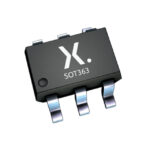 74HC2GU04GW-Q100H

The activity of extra discounts on wholesale prices is in full swing…
Please fill in your contact information and we will send you the latest wholesale price list.





