 ChipApex | Global Electronic Components Supplier
SEARCH
Search Product
Search Post
— IC芯片 | 连接器 | 传感器 | 被动器件 —
Search productSearch post
— IC芯片 | 连接器 | 传感器 | 被动器件 —
Consult the customer manager about the wholesale price.
consultation hotline:86-132-6715-2157
email:[email protected]
Contact the product manager for consultation. One-stop consultation is available.
Do you want a lower wholesale price? Please send us your inquiry and we will reply immediately.
The 74HC4053N,652 is a triple 2-channel analog multiplexer/demultiplexer manufactured by NXP USA Inc. It operates within a supply voltage range of 2.0 V to 10.0 V and features a common enable input (E). The device includes three independent switches, each with two inputs/outputs (nY0, nY1) and a common output/input (nZ), controlled by digital select inputs (S0 to S2). When the enable signal is low, one switch is selected; when high, all switches enter a high-impedance OFF-state. It supports single-ended multiplexing with an analog input voltage range from -5 V to +5 V.
Verify component authenticity through authorized Nexperia or NXP distributors. Confirm package integrity and pin alignment against the PDIP-16 specification. Check manufacturing date codes for lifecycle status, as availability may vary due to production transitions. Ensure storage conditions comply with moisture sensitivity levels to prevent soldering defects during assembly.
Select this component for designs requiring multiple analog channels to share a single processing line. Verify that the required analog voltage swing remains within the specified -5 V to +5 V range relative to the supply rails. Consider the ON resistance variation across temperature if signal accuracy is critical. Ensure the control logic voltage matches the 2.0 V to 10.0 V operating range for reliable switching.
This part belongs to the 74HC series of high-speed CMOS logic devices. It serves as a functional equivalent to older HEF4053B components while offering improved switching speeds. The device is designed for general-purpose analog switching tasks where low power consumption and wide supply voltage flexibility are required. It complements other 74HC family members like the 74HC4066 for complex switching matrices.
The 74HCT4053 is a compatible alternative but requires a strict 4.5 V to 5.5 V supply voltage. Other 74HC series multiplexers may offer different channel counts or package types. Verify pin compatibility and electrical specifications before substitution to ensure circuit functionality remains unchanged.
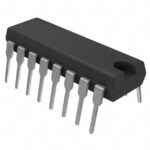 74HC4053N,652
The activity of extra discounts on wholesale prices is in full swing…
Please fill in your contact information and we will send you the latest wholesale price list.





