 ChipApex | Global Electronic Components Supplier
SEARCH
Search Product
Search Post
— IC芯片 | 连接器 | 传感器 | 被动器件 —
Search productSearch post
— IC芯片 | 连接器 | 传感器 | 被动器件 —
Consult the customer manager about the wholesale price.
consultation hotline:86-132-6715-2157
email:[email protected]
Contact the product manager for consultation. One-stop consultation is available.
Do you want a lower wholesale price? Please send us your inquiry and we will reply immediately.
The Toshiba 74HC4066D is a high-speed CMOS quad bilateral switch fabricated with silicon gate technology. It consists of four independent switches capable of controlling digital or analog signals while maintaining low power dissipation. The device operates within a supply voltage range of 2.0 V to 12.0 V and supports an operating temperature range of -40 °C to 125 °C for units manufactured after July 2020. Key electrical parameters include a typical ON-resistance (RON) of 50 Ω at VCC = 9.0 V, a maximum quiescent supply current (ICC) of 8.0 µA at VCC = 12.0 V, and a typical total harmonic distortion (THD) of 0.05% at VCC = 4.5 V. The component is housed in a SOIC-14 package.
Verify the manufacturing date of the specific unit to confirm compliance with the extended operating temperature range specification. The Topr = -40 °C to 125 °C rating applies exclusively to products manufactured after July 2020. Earlier production batches may adhere to different thermal specifications. Ensure that the procurement source provides accurate lot information to validate this critical operational parameter.
Select the 74HC4066D when a quad bilateral switch configuration is required within standard HC logic families. Verify that the application voltage falls within the 2.0 V to 12.0 V range. Consider the SOIC-14 package constraints for PCB layout. Confirm that the required operating temperature aligns with the manufacturing date specifications to ensure proper thermal performance ratings are met.
The 74HC4066D belongs to the 74HC series of high-speed CMOS logic devices produced by Toshiba Semiconductor and Storage. This series utilizes silicon gate C2MOS technology to achieve performance comparable to LS TTL while maintaining low power consumption. The component functions as a fundamental building block for analog switching and signal routing within broader digital logic systems.
Cross-reference with other manufacturers' 74HC4066 equivalents to verify pin compatibility and electrical parameter alignment. Ensure that substitute components support the same SOIC-14 package and meet the required voltage and temperature specifications for the intended application environment.
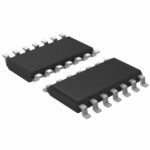 74HC4066D
The activity of extra discounts on wholesale prices is in full swing…
Please fill in your contact information and we will send you the latest wholesale price list.





