 ChipApex | Global Electronic Components Supplier
SEARCH
Search Product
Search Post
— IC芯片 | 连接器 | 传感器 | 被动器件 —
Search productSearch post
— IC芯片 | 连接器 | 传感器 | 被动器件 —
Consult the customer manager about the wholesale price.
consultation hotline:86-132-6715-2157
email:[email protected]
Contact the product manager for consultation. One-stop consultation is available.
Do you want a lower wholesale price? Please send us your inquiry and we will reply immediately.
The Renesas 74HC4511FP-E is a BCD-to-7-segment decoder and driver designed for direct interface with common-anode LED displays. It integrates input latching, decoding logic, and high-current output drivers to simplify digital display systems. The device accepts 4-bit binary-coded decimal inputs and converts them into the appropriate signals to illuminate specific segments of a seven-segment indicator. This component facilitates stable numeric representation in electronic circuits by handling both data storage and signal translation within a single integrated circuit package.
Verify the exact suffix 'FP-E' against official Renesas documentation to confirm pinout compatibility and temperature range specifications. Ensure that the common-anode requirement matches your display hardware. Cross-reference the manufacturer's latest datasheet revision to confirm active status and any potential obsolescence notices before finalizing procurement plans.
Select this component when a combined decoding and driving solution is required for common-anode LEDs. It eliminates the need for separate decoder chips and current-limiting resistors on each segment line, reducing board space and assembly complexity. Consider the operating voltage range and output current capabilities relative to the specific LED display characteristics to ensure reliable operation under varying load conditions.
This part belongs to the HC (High-speed CMOS) logic family, offering faster switching speeds compared to standard TTL equivalents while maintaining low power consumption. The FP-E designation typically indicates a specific plastic package variant, often a flat pack or similar form factor, suitable for through-hole mounting. It serves as a foundational component in legacy and modern digital systems requiring straightforward numeric visualization.
Compatible substitutes include other BCD-to-7-segment decoders from various manufacturers that support common-anode displays. Verify logical equivalence regarding pin assignments, specifically the latch, lamp test, and blanking functions. Ensure replacement parts meet the same voltage and current drive requirements to maintain system performance without redesigning the surrounding circuitry.
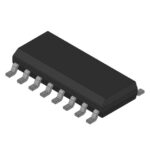 74HC4511FP-E
The activity of extra discounts on wholesale prices is in full swing…
Please fill in your contact information and we will send you the latest wholesale price list.





