 ChipApex | Global Electronic Components Supplier
SEARCH
Search Product
Search Post
— IC芯片 | 连接器 | 传感器 | 被动器件 —
Search productSearch post
— IC芯片 | 连接器 | 传感器 | 被动器件 —
Consult the customer manager about the wholesale price.
consultation hotline:86-132-6715-2157
email:[email protected]
Contact the product manager for consultation. One-stop consultation is available.
Do you want a lower wholesale price? Please send us your inquiry and we will reply immediately.
The 74HC5555 is a precision programmable delay timer featuring a 24-stage binary counter, integrated oscillator, and retriggerable/non-retriggerable monostable circuitry. It operates on a supply voltage range of 2.0 V to 6.0 V with CMOS input levels. The device supports positive and negative edge triggering, Schmitt trigger inputs for noise immunity, and an overriding asynchronous master reset. It includes automatic power-ON reset and clamp diodes for input protection. The component provides high-precision digital timing with divide-by ranges from 2 to 2^24.
Verify the package type matches the required form factor; the 74HC5555N variant typically utilizes an SO16 (SOT109-1) plastic small outline package. Confirm the temperature grade aligns with system requirements, as the datasheet specifies operation from -40 °C to +125 °C. Ensure ordering suffixes correspond to the specific manufacturer versioning, such as Nexperia or NXP, as these may affect documentation but not electrical function.
Select this component when precise digital delay generation is required without external microcontrollers. The choice between RC, crystal, or external oscillation depends on frequency stability needs. For applications requiring low power during standby, utilize the triggered start mode by setting OSC CON LOW. Ensure the external timing components (RT, CT) are selected within the recommended limits to maintain accuracy better than 1% for delays ≥ 400 ns.
The 74HC5555 belongs to the 74HC/HCT series of high-speed Si-gate CMOS logic devices. It is pin-compatible with low-power Schottky TTL (LSTTL) standards. The device complies with JEDEC standard no. 7A and features ESD protection exceeding 2000 V (HBM). It serves as a direct replacement for older analog timer solutions in digital designs requiring programmable intervals.
Public confirmed substitute part numbers include the 74HCT5555 for TTL-compatible logic levels. Other programmable delay timers like the LS7210 or LS7211 series offer similar functionality but may require interface adjustments.

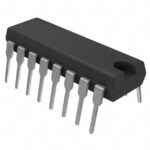 74HC5555N,112
The activity of extra discounts on wholesale prices is in full swing…
Please fill in your contact information and we will send you the latest wholesale price list.



