 ChipApex | Global Electronic Components Supplier

SEARCH
Search Product
Search Post
— IC芯片 | 连接器 | 传感器 | 被动器件 —
Search productSearch post
— IC芯片 | 连接器 | 传感器 | 被动器件 —
Consult the customer manager about the wholesale price.
consultation hotline:86-132-6715-2157
email:[email protected]
Contact the product manager for consultation. One-stop consultation is available.
Do you want a lower wholesale price? Please send us your inquiry and we will reply immediately.
The onsemi 74HCT14DR2G is a hex Schmitt-trigger inverter manufactured using high-performance silicon-gate CMOS technology. It features LSTTL-compatible inputs and operates within a DC supply voltage range of 4.5 V to 5.5 V. The device provides an output drive capability equivalent to 10 LSTTL loads, with maximum propagation delays of 32 ns at 5.0 V and 50 pF load conditions. It includes ESD protection rated above 2000 V via the Human Body Model and is available in a lead-free SOIC-14 package.
Verify the specific suffix 'DR2G' against the manufacturer's current ordering information to confirm availability and exact package configuration. Confirm RoHS compliance status as indicated by the 'G' suffix. Ensure the procurement channel sources directly from authorized distributors to guarantee component authenticity and traceability.
Select this component when interfacing legacy TTL or NMOS logic families with modern high-speed CMOS circuits. The integrated Schmitt triggers are essential for applications involving signals with slow transition rates or significant electrical noise. Verify that the system power supply remains strictly within the 4.5 V to 5.5 V operating range for optimal performance.
This part belongs to the 74HCT series of hex inverters designed for 5 V systems. It utilizes silicon-gate CMOS technology to achieve high switching speeds while maintaining compatibility with standard transistor-transistor logic (TTL) input thresholds. The device serves as a bridge between older logic standards and advanced CMOS implementations.
Direct substitutes include MC74HCT14ADR2G and MC74HCT14ADTR2G from onsemi. Other compatible alternatives may include devices from Texas Instruments or Diodes Incorporated within the same 74HCT logic family, provided pinouts and electrical characteristics match.
The Schmitt trigger input provides hysteresis, which helps eliminate noise and ensures clean signal transitions even when the input signal has slow rise or fall times.
Yes, the 74HCT14DR2G features LSTTL-compatible input levels, allowing it to interface directly with TTL or NMOS outputs without additional level shifting components.
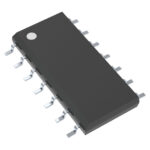 74HCT14DR2G

The activity of extra discounts on wholesale prices is in full swing…
Please fill in your contact information and we will send you the latest wholesale price list.





