 ChipApex | Global Electronic Components Supplier
SEARCH
Search Product
Search Post
— IC芯片 | 连接器 | 传感器 | 被动器件 —
Search productSearch post
— IC芯片 | 连接器 | 传感器 | 被动器件 —
Consult the customer manager about the wholesale price.
consultation hotline:86-132-6715-2157
email:[email protected]
Contact the product manager for consultation. One-stop consultation is available.
Do you want a lower wholesale price? Please send us your inquiry and we will reply immediately.
The Nexperia 74HCT4538D,118 is a dual retriggerable-resettable monostable multivibrator housed in an SO16 (SOT109-1) plastic small outline package. It operates within a supply voltage range of 4.5 V to 5.5 V and supports ambient temperatures from -40 °C to +125 °C. The device features TTL input levels and CMOS low power dissipation. Each multivibrator includes two trigger/retrigger inputs (nA and nB), a direct reset input (nCD), complementary outputs (nQ and nQ), and pins for external timing components CEXT and REXT. Pulse width is determined by the formula TW = 0.7 × REXT × CEXT.
Verify that the ordering suffix matches the required package type. Confirm the specific temperature range requirements align with the component's specified operating limits. Ensure the design accounts for the absolute maximum ratings to prevent permanent damage during operation or power-down sequences.
Select this component when precise monostable timing is required with HCT logic compatibility. Consider the SO16 package constraints regarding body width and lead pitch. Evaluate the need for retriggering capabilities and the availability of external timing components to set the desired pulse width accurately.
This part belongs to the 74HCT series of logic ICs, designed for high-speed CMOS operations with TTL-compatible inputs. The 74HCT4538 variant specifically provides dual independent monostable multivibrators. It is distinct from the HC series by its input voltage thresholds and is intended for applications requiring robust noise immunity and precise timing control.
The 74HCT4538PW,118 serves as a functional substitute using a TSSOP16 package. Verify pinout compatibility and thermal characteristics when switching between SO16 and TSSOP16 packages.
The output pulse width (TW) is determined by the external timing components connected to the nREXT/CEXT and nCEXT pins, calculated using the formula TW = 0.7 × REXT × CEXT.
Yes, the device can be triggered by either the positive edge (via input nB) or the negative edge (via input nA) of the input pulse.
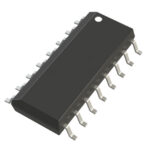 74HCT4538D,118
The activity of extra discounts on wholesale prices is in full swing…
Please fill in your contact information and we will send you the latest wholesale price list.






