 ChipApex | Global Electronic Components Supplier
SEARCH
Search Product
Search Post
— IC芯片 | 连接器 | 传感器 | 被动器件 —
Search productSearch post
— IC芯片 | 连接器 | 传感器 | 被动器件 —
Consult the customer manager about the wholesale price.
consultation hotline:86-132-6715-2157
email:[email protected]
Contact the product manager for consultation. One-stop consultation is available.
Do you want a lower wholesale price? Please send us your inquiry and we will reply immediately.
The SN74LVC1G123DCTRE4 is a single retriggerable monostable multivibrator from the Texas Instruments LVC logic family. It operates within a supply voltage range of 1.65 V to 5.5 V and supports standard voltages including 1.8 V, 2.5 V, 3.3 V, and 5 V. The device features Schmitt-trigger inputs for noise immunity and delivers output currents of ±32 mA. Propagation delay is specified at 18.6 ns, with a maximum static current of 20 µA. It functions reliably across an extended temperature range from -40°C to +125°C and is housed in an 8-pin VSSOP package.
Verify the complete part number including the E4 suffix to confirm lead-free compliance and specific tape-and-reel packaging configuration. Ensure the ordering code matches the required VSSOP-8 variant. Confirm RoHS status and moisture sensitivity level requirements against project specifications prior to procurement to avoid compatibility issues with assembly processes.
Select this component when a compact, low-power solution for generating fixed-duration pulses is required. The wide voltage range suits diverse power environments, while the high output current simplifies load driving. Verify that the external resistor and capacitor values align with the desired pulse duration formula provided in the datasheet. Consider the thermal performance and package size constraints relative to the PCB layout density.
This device belongs to the SN74LVC1G123 series, designed for general-purpose timing applications in portable and battery-operated electronics. The LVC family offers improved speed and lower power consumption compared to older logic standards. The DCTRE4 designation indicates a specific manufacturing lot and reel configuration for surface-mount assembly, ensuring consistency in production yields and handling characteristics.
Direct substitutes include other SN74LVC1G123 variants with different packaging or suffixes, such as SN74LVC1G123DCTT or SN74LVC1G123DCUR. Cross-manufacturer equivalents like Nexperia 74LVC1G123DP may require verification of pinout and electrical parameter alignment. Always validate functional equivalence through detailed datasheet comparison before implementation.
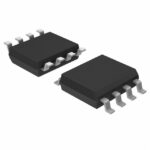 74LVC1G123DCTRE4
The activity of extra discounts on wholesale prices is in full swing…
Please fill in your contact information and we will send you the latest wholesale price list.







