 ChipApex | Global Electronic Components Supplier
SEARCH
Search Product
Search Post
— IC芯片 | 连接器 | 传感器 | 被动器件 —
Search productSearch post
— IC芯片 | 连接器 | 传感器 | 被动器件 —
Consult the customer manager about the wholesale price.
consultation hotline:86-132-6715-2157
email:[email protected]
Contact the product manager for consultation. One-stop consultation is available.
Do you want a lower wholesale price? Please send us your inquiry and we will reply immediately.
The National Semiconductor 74S113PC is a dual J-K flip-flop belonging to the 74S (Schottky) logic family. It features two independent negative-edge-triggered flip-flops with complementary outputs and dedicated preset and clear inputs. The device utilizes Schottky clamping diodes to minimize propagation delay and prevent saturation, ensuring high-speed switching performance. Packaged in a standard 14-pin DIP format, it operates within a specified voltage range suitable for TTL-compatible systems.
Verify the manufacturer origin as National Semiconductor or its successor Texas Instruments, noting that legacy production may be discontinued. Confirm the package type matches the 14-pin DIP specification. Check for RoHS compliance status if required by current regulations, as older S-series parts may not meet modern environmental standards. Ensure the part number suffix 'PC' correctly denotes the plastic DIP variant.
Select this component when specific high-speed switching characteristics of the Schottky family are required over standard LS series alternatives. Consider the availability of complementary outputs if signal inversion stages need to be minimized in the design. Evaluate the operating temperature range and supply voltage requirements against system constraints before finalizing the choice.
The 74S113 is part of the broader 7400-series logic family, specifically the Schottky (S) sub-family known for improved speed-power trade-offs. It serves as a functional equivalent to other dual J-K flip-flops but distinguishes itself through faster propagation delays due to internal Schottky diodes. This component represents a classic discrete logic solution for sequential circuit design prior to the widespread adoption of complex programmable logic devices.
The 74LS112 is a common alternative offering similar functionality but with lower speed and power consumption. The 74HC112 provides CMOS compatibility with higher input impedance. Verify pinout compatibility and electrical characteristics such as drive strength and switching speeds when substituting these variants.
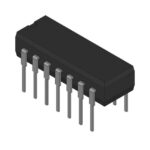 74S113PC
The activity of extra discounts on wholesale prices is in full swing…
Please fill in your contact information and we will send you the latest wholesale price list.






