 ChipApex | Global Electronic Components Supplier
SEARCH
Search Product
Search Post
— IC芯片 | 连接器 | 传感器 | 被动器件 —
Search productSearch post
— IC芯片 | 连接器 | 传感器 | 被动器件 —
Consult the customer manager about the wholesale price.
consultation hotline:86-132-6715-2157
email:[email protected]
Contact the product manager for consultation. One-stop consultation is available.
Do you want a lower wholesale price? Please send us your inquiry and we will reply immediately.
The Fairchild Semiconductor 74VHC221ASJ is a dual monostable multivibrator integrated circuit belonging to the 74VHC series. It features two independent circuits within a single package, utilizing CMOS technology for low power consumption and high noise immunity. The device operates with a supply voltage range of 2 V to 5.5 V and supports surface mount installation in a 16-SOP (SOIC) package with a width of 5.30 mm. It exhibits a propagation delay of 8.1 ns and provides complementary outputs. The component is rated for an operating temperature range of -40°C to 85°C and includes Schmitt trigger inputs for improved signal conditioning.
Verify part authenticity through authorized distributors or direct manufacturer channels. Confirm the specific suffix ASJ matches the required 16-SOP package and tape-and-reel quantity specifications. Check RoHS compliance status and ensure the component meets environmental regulations for the target market. Validate that the source documentation corresponds to the exact Fairchild Semiconductor designation to avoid substitution errors.
Select this component when dual independent timing functions are required in a compact surface-mount form factor. The 74VHC series offers compatibility with standard 5 V logic systems while supporting lower voltage operation down to 2 V. Ensure the application benefits from Schmitt trigger input characteristics for clean switching. Consider the 8 mA drive capability for moderate load requirements.
The 74VHC221 is part of the broader 74VHC family of high-speed CMOS logic devices. This family is designed for high-speed digital applications requiring low power dissipation. The 221 variant specifically addresses monostable multivibrator needs, providing reliable one-shot pulse generation capabilities. It serves as a functional equivalent to other industry-standard monostable timers within the same voltage and speed class.
The SN74LV221ANSR from Texas Instruments is documented as a direct substitute. Verify pinout compatibility and electrical parameter alignment before implementation.
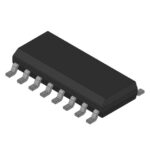 74VHC221ASJ
The activity of extra discounts on wholesale prices is in full swing…
Please fill in your contact information and we will send you the latest wholesale price list.





