 ChipApex | Global Electronic Components Supplier
SEARCH
Search Product
Search Post
— IC芯片 | 连接器 | 传感器 | 被动器件 —
Search productSearch post
— IC芯片 | 连接器 | 传感器 | 被动器件 —
Consult the customer manager about the wholesale price.
consultation hotline:86-132-6715-2157
email:[email protected]
Contact the product manager for consultation. One-stop consultation is available.
Do you want a lower wholesale price? Please send us your inquiry and we will reply immediately.
The 78P2241B-IGT/F is a single-chip line interface transceiver IC designed for E3, DS3, STS-1, NAT T3, and ATM applications. It operates at speeds up to 51.84 Mbps over 75-ohm coaxial cable with distances up to 1100 feet. The device integrates clock recovery, transmitter pulse shaping, and a selectable B3ZS/HDB3 encoder/decoder. It supports both 5V and 3.3V power supplies while consuming less than 110 mA of supply current. The receiver compensates for over 12dB of cable loss and includes a line code violation detector. Manufactured in an advanced BICMOS process, it provides transformer or capacitor coupling options.
Verify the package type matches the required design, as the 78P2241B is available in 28-pin PLCC and 48-pin TQFP configurations. Confirm that the ordering suffix indicates lead-free compliance if environmental regulations require it. Ensure the specific variant selected aligns with the pinout compatibility requirements for existing designs referencing the 78P7200.
Select the appropriate RFO resistor value to configure the operational speed for E3, DS3, or STS-1 standards. Choose between 28-pin PLCC or 48-pin TQFP packages based on board space and pin compatibility needs. Consider the LBO pin configuration for line build-out depending on the connected cable length. Verify that the framer interface supports the required clock polarity settings via the ICKP pin.
The 78P2241B is manufactured by Teridian Semiconductor Corporation and serves as a successor to the 78P7200. It maintains pin and functional compatibility with the 78P7200 in the 28-pin PLCC package and the 78P2241 in the same package. The device adds features such as a B3ZS/HDB3 ENDEC, line code violation detection, and monitor signal reception capabilities not present in earlier models.
The 78P2241B is a direct replacement for the 78P7200 in 28-pin PLCC designs. It is also compatible with the 78P2241 in the 28-pin PLCC and 48-pin TQFP packages. When replacing the 78P7200, external components such as input filters and transformers may require modification to match the new specifications.
The device employs a phase-locked loop with an auxiliary frequency-sensitive acquisition loop, allowing it to lock to the incoming data stream's frequency and phase without requiring an external high-precision tuned circuit or reference clock signal.
The MON pin selects between normal receive range and monitor mode. When set high, it activates an additional 20-dB gain stage in the receiver, allowing it to detect low-amplitude DSX3 or E3 monitor signals.
The ENDEC pin controls the encoder/decoder function. When set low, it activates the B3ZS/HDB3 ENDEC, converting NRZ input data to AMI pulses for transmission and decoding received AMI signals back to NRZ data.
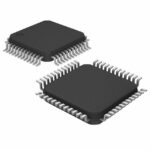 78P2241B-IGT/F
The activity of extra discounts on wholesale prices is in full swing…
Please fill in your contact information and we will send you the latest wholesale price list.






