 ChipApex | Global Electronic Components Supplier

SEARCH
Search Product
Search Post
— IC芯片 | 连接器 | 传感器 | 被动器件 —
Search productSearch post
— IC芯片 | 连接器 | 传感器 | 被动器件 —
Consult the customer manager about the wholesale price.
consultation hotline:86-132-6715-2157
email:[email protected]
Contact the product manager for consultation. One-stop consultation is available.
Do you want a lower wholesale price? Please send us your inquiry and we will reply immediately.
The A3PN060-1VQG100 is a ProASIC3 nano Flash FPGA manufactured by Microchip Technology. It features 700 logic elements and 71 user I/Os in a 100-pin VQFP package (14x14 mm). The device operates with a core voltage range of 1.425 V to 1.575 V and supports system performance up to 350 MHz. It utilizes a 130-nm flash-based CMOS process, providing non-volatile configuration retention without external memory. The component includes embedded SRAM for data storage and supports mixed-voltage I/O standards.
Verify the specific suffix designation against official Microchip documentation to confirm temperature grade and packaging details. Ensure compatibility with existing board layouts regarding the 100-VQFP footprint and thermal requirements. Confirm supply chain authenticity through authorized distributors to avoid counterfeit components. Check for any recent Product Change Notifications affecting pinout or electrical specifications.
Select this model when a small form factor FPGA with immediate power-up capability is required. Compare logic density against the broader ProASIC3 nano family to ensure sufficient resources for the target design. Evaluate power consumption constraints given the 1.5 V core voltage requirement. Consider the 350 MHz maximum frequency for timing closure in high-speed synchronous designs.
This component belongs to the ProASIC3 nano family, which bridges the gap between standard ASICs and larger FPGAs. The series emphasizes low power consumption and radiation tolerance characteristics suitable for specialized environments. It shares pin compatibility within its package type across different logic densities in the same family, simplifying design upgrades.
Direct substitutes include other variants within the ProASIC3 nano series such as A3PN015 or A3PN020 if lower logic density suffices. Verify pin-to-pin compatibility for the VQFP-100 package before substitution. Cross-reference electrical parameters like I/O voltage levels and operating temperature ranges to ensure functional equivalence.


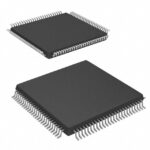 A3PN060-1VQG100

The activity of extra discounts on wholesale prices is in full swing…
Please fill in your contact information and we will send you the latest wholesale price list.




