 ChipApex | Global Electronic Components Supplier

SEARCH
Search Product
Search Post
— IC芯片 | 连接器 | 传感器 | 被动器件 —
Search productSearch post
— IC芯片 | 连接器 | 传感器 | 被动器件 —
Consult the customer manager about the wholesale price.
consultation hotline:86-132-6715-2157
email:[email protected]
Contact the product manager for consultation. One-stop consultation is available.
Do you want a lower wholesale price? Please send us your inquiry and we will reply immediately.
The A42MX09-PQ160I is a Field Programmable Gate Array (FPGA) from the Microchip MX series, manufactured by Microchip Technology. It features approximately 14,000 system gates and 336 Logic Elements (LEs). The device supports 101 I/O pins and operates within a supply voltage range of 4.75V to 5.25V, with an alternative specification of 3V to 3.6V. It is housed in a 160-pin PQFP package with dimensions of 28x28 mm. The component is rated for an operating temperature range of 0°C to 70°C (TA). Moisture Sensitivity Level (MSL) is 3 (168 hours). The part status is listed as Obsolete/End-of-Life.
This component is officially classified as obsolete or end-of-life by the manufacturer. Verification of availability should focus on surplus distributors or secondary market sources rather than direct manufacturing channels. Buyers must confirm the specific revision level and RoHS compliance status, as legacy stock may vary in environmental certification. Lead times are not applicable due to discontinuation status.
Engineers selecting this part should consider its non-volatile flash technology which eliminates the need for external configuration PROMs. The 160-pin PQFP package offers a surface-mount solution suitable for space-constrained designs. Designers must account for the limited I/O count of 101 pins when mapping interface requirements. Migration strategies to newer Microchip FPGA families should be evaluated given the discontinued status.
The A42MX09 belongs to the Actel/Microchip MX family of flash FPGAs, known for their radiation tolerance and low power consumption. This specific model represents a mid-range density option within the series, bridging lower-density CPLDs and higher-end FPGAs. The 'PQ160' suffix denotes the plastic quad flat pack package type with 160 leads.
Direct pin-to-pin replacements are not publicly confirmed for this obsolete part. Engineers should evaluate Microchip's PolarFire or IGLOO2 families for modern equivalents, though these require schematic and layout redesigns due to architectural differences and varying package options.


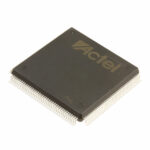 A42MX09-PQ160I

The activity of extra discounts on wholesale prices is in full swing…
Please fill in your contact information and we will send you the latest wholesale price list.



