 ChipApex | Global Electronic Components Supplier

SEARCH
Search Product
Search Post
— IC芯片 | 连接器 | 传感器 | 被动器件 —
Search productSearch post
— IC芯片 | 连接器 | 传感器 | 被动器件 —
Consult the customer manager about the wholesale price.
consultation hotline:86-132-6715-2157
email:[email protected]
Contact the product manager for consultation. One-stop consultation is available.
Do you want a lower wholesale price? Please send us your inquiry and we will reply immediately.
The A42MX09-PQ160M is a Field Programmable Gate Array (FPGA) from the Microchip MX family, designed as a single-chip ASIC alternative for automotive applications. It features 14,000 system gates and 336 Logic Elements (LEs). The device supports dual voltage supplies: 3V to 3.6V and 4.75V to 5.25V. It offers 101 I/Os in a 160-BQFP package. Operating temperature ranges from 0°C to 70°C (TA). Key specifications include up to 2.5 kbits of configurable dual-port SRAM, fast wide-decode circuitry, and IEEE 1149.1 JTAG boundary scan support.
Verify component authenticity through authorized Microchip distributors or direct manufacturer channels. Confirm RoHS compliance status and REACH registration details prior to integration. Check for obsolescence notices or PCN updates regarding assembly site changes. Ensure proper ESD handling procedures are followed during storage and installation due to moisture sensitivity level 3 classification.
Select this model when 14,000 system gates and 101 I/Os meet design requirements. Choose the PQ160M variant for surface mount assembly in 160-pin QFP packages. Verify voltage supply compatibility with 3.3V or 5V domains. Consider thermal management for industrial temperature ranges if operating near upper limits. Evaluate memory needs against the 2.5 kbit SRAM capacity.
This part belongs to the Microchip MX FPGA family, which bridges the gap between CPLDs and high-end FPGAs. The MX series is optimized for cost-sensitive applications requiring moderate logic density and low power. It shares architectural similarities with other A42MX devices but differs in gate count and I/O configuration. The family supports flash-based non-volatile programming without external configuration memory.
Direct substitutes within the same package may include A42MX09 variants with different speed grades or temperature ratings. Cross-family replacements might involve A40MX series devices with lower gate counts. Verify pin-to-pin compatibility and electrical characteristics before substitution. Consult Microchip documentation for specific upgrade paths or end-of-life alternatives.
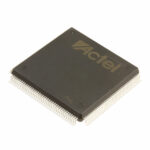 A42MX09-PQ160M

The activity of extra discounts on wholesale prices is in full swing…
Please fill in your contact information and we will send you the latest wholesale price list.






