 ChipApex | Global Electronic Components Supplier

SEARCH
Search Product
Search Post
— IC芯片 | 连接器 | 传感器 | 被动器件 —
Search productSearch post
— IC芯片 | 连接器 | 传感器 | 被动器件 —
Consult the customer manager about the wholesale price.
consultation hotline:86-132-6715-2157
email:[email protected]
Contact the product manager for consultation. One-stop consultation is available.
Do you want a lower wholesale price? Please send us your inquiry and we will reply immediately.
The A42MX16-2PQ160I is a Flash-based Field Programmable Gate Array from the Microchip MX Automotive family, designed as a single-chip ASIC alternative for automotive applications. It features 24,000 system gates and 608 Logic Elements within a PQFP-160 package. The device supports 125 I/Os and operates on a 5V supply voltage with a range of 4.75V to 5.25V. It functions within an industrial temperature range of -40°C to +125°C. Key specifications include up to 2.5 kbits of configurable dual-port SRAM, deterministic timing, and support for IEEE Standard 1149.1 JTAG boundary scan testing.
Verify component authenticity through authorized Microchip distributors or certified partners due to potential counterfeit risks in the aftermarket. Confirm RoHS compliance status and moisture sensitivity level (MSL) handling requirements prior to assembly. Review official Product Change Notices (PCNs) for any recent manufacturing or packaging updates that may affect compatibility or lead times.
Select this model when a 5V tolerant interface is required alongside high I/O density in a QFP package. Ensure the design utilizes the specific 24K gate capacity efficiently given the fixed pin count. Compare against the A42MX series variants if different temperature grades or package sizes are needed for space-constrained automotive PCB layouts.
This component belongs to the Actel MX Automotive FPGA family, now manufactured by Microchip Technology following their acquisition of Actel. The series is distinguished by its non-volatile Flash technology, which eliminates the need for external configuration memory commonly found in SRAM-based FPGAs. This integration reduces board space and enhances reliability in harsh automotive environments.
Direct pin-to-pin replacements within the same package are limited. Consider the A42MX16-2PQG160I for equivalent performance in a QFN variant, though pinout differences exist. For legacy Actel parts, verify functional equivalence carefully as architectural differences between Flash and other FPGA technologies may require significant design rework.


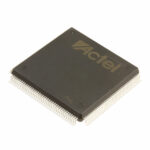 A42MX16-2PQ160I

The activity of extra discounts on wholesale prices is in full swing…
Please fill in your contact information and we will send you the latest wholesale price list.




