 ChipApex | Global Electronic Components Supplier

SEARCH
Search Product
Search Post
— IC芯片 | 连接器 | 传感器 | 被动器件 —
Search productSearch post
— IC芯片 | 连接器 | 传感器 | 被动器件 —
Consult the customer manager about the wholesale price.
consultation hotline:86-132-6715-2157
email:[email protected]
Contact the product manager for consultation. One-stop consultation is available.
Do you want a lower wholesale price? Please send us your inquiry and we will reply immediately.
The A42MX24-1PQ160M is a high-performance Field Programmable Gate Array (FPGA) from the Microchip MX Automotive family. It features 36,000 system gates and 912 logic elements within a 160-pin PQFP package. The device supports mixed-voltage operation with core voltages of 3.3V or 5.0V and I/Os compatible with PCI standards. It includes up to 2.5 kbits of configurable dual-port SRAM and fast wide-decode circuitry for deterministic timing. Designed for automotive applications, it offers single-chip ASIC alternative capabilities with user-controllable timing and in-system diagnostic support.
Verify component authenticity through authorized Microchip distributors due to potential supply chain variations. Confirm RoHS compliance status as specific revisions may differ. Check for moisture sensitivity level requirements prior to soldering. Ensure packaging integrity matches storage specifications. Validate part markings against official datasheet documentation to prevent counterfeit risks.
Select this model when 36,000 system gates are required for complex logic implementations. Choose the PQFP-160 package for surface-mount assembly compatibility. Opt for this variant if mixed-voltage I/O interfaces are necessary for legacy system integration. Consider the automotive temperature range if operating in harsh environments. Verify pin-locking requirements match the specific application constraints.
This component belongs to the Microchip MX Automotive FPGA family, designed as a single-chip ASIC alternative. The series ranges from 3,000 to 54,000 system gates, offering scalable logic density. The A42MX24 variant specifically targets applications requiring high gate counts with low power consumption. It integrates fast wide-decode circuitry and configurable SRAM for flexible system architectures.
Direct substitutes include other A42MX24 variants with different speed grades or packages, such as A42MX24-2PQG160I. Cross-reference pinouts and voltage levels when considering upgrades within the MX family. Verify that alternative packages maintain the same I/O count and functionality.
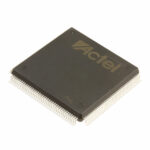 A42MX24-1PQ160M

The activity of extra discounts on wholesale prices is in full swing…
Please fill in your contact information and we will send you the latest wholesale price list.






