 ChipApex | Global Electronic Components Supplier

SEARCH
Search Product
Search Post
— IC芯片 | 连接器 | 传感器 | 被动器件 —
Search productSearch post
— IC芯片 | 连接器 | 传感器 | 被动器件 —
Consult the customer manager about the wholesale price.
consultation hotline:86-132-6715-2157
email:[email protected]
Contact the product manager for consultation. One-stop consultation is available.
Do you want a lower wholesale price? Please send us your inquiry and we will reply immediately.
The A42MX24-2PQG160 is a Field Programmable Gate Array (FPGA) from the Microchip MX family, housed in a PQFP-160 package. It provides 36,000 system gates and 912 Logic Elements. The device supports dual voltage operation at 3.3 V and 5 V, with supply rails ranging from 4.75 V to 5.25 V for 5V logic and corresponding levels for 3.3V. It features 125 I/O pins and operates within a commercial temperature range of 0°C to +70°C. The component utilizes SRAM-based technology and includes JTAG boundary scan capabilities.
Verify current availability status as this component may be subject to discontinuation notices. Confirm that the specific PQFP-160 package variant matches your PCB footprint requirements. Ensure compliance with RoHS directives if applicable to your manufacturing standards. Check for any pending Product Change Notifications regarding assembly sites or material updates before finalizing procurement plans.
Select this model when 36,000 system gates and 125 I/Os are required in a PQFP-160 form factor. Consider the 0°C to +70°C operating range against your environmental constraints. Verify that the SRAM-based configuration architecture aligns with your non-volatile memory strategy. Compare pin counts and voltage tolerances against alternative MX family devices like the A42MX24-PQ208A if more I/Os are needed.
This FPGA belongs to the Microchip A42MX series, designed as single-chip ASIC alternatives for automotive and industrial applications. The series offers synthesis-friendly architectures supporting up to 100% resource utilization. Devices in this family typically feature wide-decode circuitry and configurable dual-port SRAM blocks to facilitate efficient design implementation.
The A42MX24-2PQG160I serves as a verified industry substitute offering identical electrical specifications and pinout compatibility. Both variants share the same 36,000 gate capacity and PQFP-160 package dimensions. Verify that the suffix designation does not imply different thermal or voltage ratings for your specific application context.
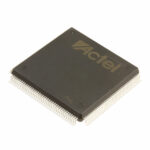 A42MX24-2PQG160

The activity of extra discounts on wholesale prices is in full swing…
Please fill in your contact information and we will send you the latest wholesale price list.






