 ChipApex | Global Electronic Components Supplier

SEARCH
Search Product
Search Post
— IC芯片 | 连接器 | 传感器 | 被动器件 —
Search productSearch post
— IC芯片 | 连接器 | 传感器 | 被动器件 —
Consult the customer manager about the wholesale price.
consultation hotline:86-132-6715-2157
email:[email protected]
Contact the product manager for consultation. One-stop consultation is available.
Do you want a lower wholesale price? Please send us your inquiry and we will reply immediately.
The A54SX08A-1TQG100I is an SX-A series Field Programmable Gate Array (FPGA) manufactured by Microchip Technology. It features 12,000 system gates and 768 logic modules comprising 512 combinatorial cells and 256 dedicated flip-flops. The device supports up to 81 user-programmable I/O pins and operates within a supply voltage range of 2.25V to 5.25V. It is housed in a 100-pin Thin Quad Flat Pack (TQFP) package with dimensions of 14x14 mm. The industrial temperature grade (-40°C to +85°C) ensures reliable operation in demanding environments.
Verify the specific ordering suffix 'I' corresponds to the Industrial temperature grade (-40°C to +85°C) as defined in the manufacturer's datasheet. Confirm that the 'G' suffix for RoHS compliance is included if required by your bill of materials, although standard packaging may vary. Ensure compatibility with Actel Designer software versions supported for the SX-A family prior to procurement.
Select this component when a nonvolatile FPGA solution with high-speed internal clocking up to 350 MHz is required. The SX-A architecture offers 100% pin-locking and resource utilization, facilitating concurrent PCB development. Consider the 100-TQFP package constraints for board space and thermal management relative to the device's power dissipation characteristics under load.
This part belongs to the Actel SX-A family of FPGAs, fabricated on 0.22 μm / 0.25 μm CMOS antifuse technology. The SX-A line was designed to integrate functionality previously found in multiple CPLDs or gate arrays. The A54SX08A represents the entry-level capacity within this family, offering 12,000 system gates while maintaining the same I/O and routing architecture as larger variants like the A54SX16A and A54SX32A.
Direct functional replacements within the same package and pinout are limited due to the proprietary antifuse architecture. Verify if higher-capacity SX-A devices (e.g., A54SX16A) fit mechanically and electrically if additional logic resources are needed. Cross-family migration to other FPGA technologies requires significant redesign of the logic fabric and I/O constraints.


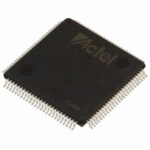 A54SX08A-1TQG100I

The activity of extra discounts on wholesale prices is in full swing…
Please fill in your contact information and we will send you the latest wholesale price list.



