 ChipApex | Global Electronic Components Supplier
SEARCH
Search Product
Search Post
— IC芯片 | 连接器 | 传感器 | 被动器件 —
Search productSearch post
— IC芯片 | 连接器 | 传感器 | 被动器件 —
Consult the customer manager about the wholesale price.
consultation hotline:86-132-6715-2157
email:[email protected]
Contact the product manager for consultation. One-stop consultation is available.
Do you want a lower wholesale price? Please send us your inquiry and we will reply immediately.
The A54SX16-2VQG100 is a Field Programmable Gate Array from the Microsemi SX-A family, utilizing antifuse technology. It provides 24,000 system gates and 1,452 configurable logic blocks (CLBs). The device supports a maximum system clock frequency of 250 MHz with an internal performance capability of 350 MHz. It features up to 81 user-programmable I/O pins and includes dedicated flip-flops for sequential logic. The component operates within a commercial temperature range of 0°C to +70°C and is housed in a 100-pin Thin Quad Flat Pack (TQFP) package.
Verify the specific speed grade suffix '2' corresponds to the required approximately 25% faster performance relative to standard speed. Confirm the 'V' package designation indicates the 100-pin TQFP form factor. Ensure the absence of an application suffix implies the Commercial temperature grade. Check for RoHS compliance markings if environmental regulations apply to the target assembly process.
Select this model when 24,000 system gates are sufficient for the design complexity. The -2 speed grade is appropriate for designs requiring higher throughput than the standard grade but less than the -1 grade. Verify that the 100-pin TQFP footprint fits the PCB layout constraints. Consider the commercial temperature range limits if the operating environment exceeds 70°C.
This part belongs to the Actel SX-A family of FPGAs, which are fabricated on a 0.22 μm / 0.25 μm CMOS process. The family is characterized by its high-density antifuse technology and support for multiple voltage standards. The A54SX16 variant sits between the A54SX08 and A54SX32 devices in terms of logic capacity and I/O count.
Public confirmed substitute part numbers are not available in the provided documentation. Cross-referencing should be performed carefully as antifuse devices are one-time programmable and pin/parameter compatibility must be verified against the specific SX-A datasheet.
DirectConnect provides a hardwired horizontal path between a C-cell and its neighboring R-cell within a SuperCluster, requiring no antifuses and offering a maximum delay of 0.1 ns. FastConnect allows routing between any two modules within a SuperCluster using only one antifuse, with a maximum pin-to-pin propagation time of 0.3 ns.
The SX-A family is power-up/down friendly, meaning VCCA and VCCI do not need to be stable during power-up and can be powered in any order. All I/Os are tristated until normal operating conditions are reached, preventing damage to the host system.
Yes, in Flexible mode, TDI, TCK, and TDO can function as user I/Os or BST pins. However, TMS cannot be employed as a user I/O in either Dedicated or Flexible modes. In Dedicated mode, all JTAG pins are reserved for Boundary Scan Testing.
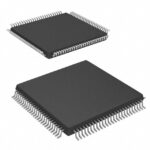 A54SX16-2VQG100
The activity of extra discounts on wholesale prices is in full swing…
Please fill in your contact information and we will send you the latest wholesale price list.






