 ChipApex | Global Electronic Components Supplier
SEARCH
Search Product
Search Post
— IC芯片 | 连接器 | 传感器 | 被动器件 —
Search productSearch post
— IC芯片 | 连接器 | 传感器 | 被动器件 —
Consult the customer manager about the wholesale price.
consultation hotline:86-132-6715-2157
email:[email protected]
Contact the product manager for consultation. One-stop consultation is available.
Do you want a lower wholesale price? Please send us your inquiry and we will reply immediately.
The A54SX16A-1TQ100 is a Field Programmable Gate Array from the Microchip Technology SX-A family, featuring 24,000 system gates and 81 user-programmable I/O pins. It operates within a supply voltage range of 2.25 V to 2.75 V, with a nominal operating voltage of 2.5 V. The device supports a maximum system performance frequency of 263 MHz and an internal clock frequency up to 350 MHz. It utilizes 0.22 μm / 0.25 μm CMOS antifuse technology and is housed in a 100-pin Thin Quad Flat Pack (TQFP) package. The component is rated for industrial temperature operation between -40°C and +85°C.
Verify the specific ordering suffix to confirm the package type, speed grade, and temperature range match the required application specifications. Confirm RoHS compliance status as packaging options vary by manufacturing batch. Check current availability status as this component may be subject to limited supply or end-of-life restrictions depending on the production date code.
Select the A54SX16A-1TQ100 when 24,000 system gates and 81 I/Os are sufficient for the design logic density. Ensure the TQFP-100 package fits the PCB footprint constraints. Verify that the -1 speed grade meets the timing requirements for the target 263 MHz system performance. Confirm that the industrial temperature range aligns with the environmental conditions of the deployment site.
This part belongs to the Actel SX-A family of FPGAs, which were originally developed by Actel Corporation before being acquired by Microchip Technology. The SX-A series is characterized by its high-density antifuse architecture and robust security features. This specific model represents a mid-range capacity device within the family, offering a balance of logic resources and I/O flexibility for general-purpose programmable logic applications.
Direct pin-compatible replacements within the same package and speed grade should be sought from the A54SX16A series, such as the A54SX16A-TQ100 or A54SX16A-2TQ100, provided the electrical characteristics and temperature ratings are compatible. Cross-family migration to newer Microchip FPGA architectures requires schematic and netlist redesign due to architectural differences.


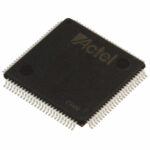 A54SX16A-1TQ100
The activity of extra discounts on wholesale prices is in full swing…
Please fill in your contact information and we will send you the latest wholesale price list.



