 ChipApex | Global Electronic Components Supplier
SEARCH
Search Product
Search Post
— IC芯片 | 连接器 | 传感器 | 被动器件 —
Search productSearch post
— IC芯片 | 连接器 | 传感器 | 被动器件 —
Consult the customer manager about the wholesale price.
consultation hotline:86-132-6715-2157
email:[email protected]
Contact the product manager for consultation. One-stop consultation is available.
Do you want a lower wholesale price? Please send us your inquiry and we will reply immediately.
The A54SX32-2PQ208I is an antifuse-based FPGA from the Microchip SX-A family, featuring 48,000 system gates and 174 user-programmable I/Os. It utilizes a 208-pin PQFP package with surface-mount installation. The device operates within a voltage range of 2.25V to 5.25V and supports industrial temperature grades (-40°C to +85°C). Key specifications include 2,880 logic modules, 1,800 combinatorial cells, and up to 1,980 dedicated flip-flops. It achieves 250 MHz system performance and 350 MHz internal clock speeds.
Verify component authenticity by checking for Actel or Microchip markings and reviewing datasheet revision history. Confirm the specific speed grade suffix matches design timing requirements. Ensure proper handling procedures are followed due to moisture sensitivity level 3 classification. Validate that the PQFP package dimensions align with PCB footprint specifications before integration.
Select this model when 48,000 system gates and 174 I/Os are required in a 208-pin PQFP form factor. The -2 speed grade offers approximately 25% faster performance than standard speed. Verify compatibility with existing 2.5 V, 3.3 V, or 5 V I/O standards. Consider the industrial temperature range if operating conditions exceed commercial limits.
This part belongs to the SX-A family of nonvolatile FPGAs fabricated on 0.22 μm / 0.25 μm CMOS technology. The family ranges from 12,000 to 108,000 system gates, offering various package options including PQFP, TQFP, and BGA types. The A54SX32 variant specifically targets designs needing moderate capacity with high-speed metal-to-metal antifuse interconnects.
A54SX32-1PQ208I: Standard speed grade alternative. A54SX32-3PQ208I: Higher speed grade option (discontinued). A54SX32-FG256A: FBGA package variant with identical logical resources.
DirectConnect provides horizontal routing between a C-cell and its neighboring R-cell within a SuperCluster using a hardwired signal path. This requires no programmable interconnection, achieving a maximum routing delay of less than 0.1 ns.
The device uses Actel Secure Programming Technology with FuseLock. This prevents unauthorized reading of the antifuse contents and includes hidden security fuses that block invasive and noninvasive probing attempts.
Yes, in Flexible mode, TDI, TCK, and TDO can function as user I/Os. However, TMS cannot be used as a user I/O in any mode. In Dedicated mode, all JTAG pins are reserved for Boundary Scan Testing.


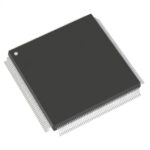 A54SX32-2PQ208I
The activity of extra discounts on wholesale prices is in full swing…
Please fill in your contact information and we will send you the latest wholesale price list.



