 ChipApex | Global Electronic Components Supplier
SEARCH
Search Product
Search Post
— IC芯片 | 连接器 | 传感器 | 被动器件 —
Search productSearch post
— IC芯片 | 连接器 | 传感器 | 被动器件 —
Consult the customer manager about the wholesale price.
consultation hotline:86-132-6715-2157
email:[email protected]
Contact the product manager for consultation. One-stop consultation is available.
Do you want a lower wholesale price? Please send us your inquiry and we will reply immediately.
The A54SX32A-1TQ144 is a Field Programmable Gate Array from the SX-A family, fabricated using 0.22 μm / 0.25 μm CMOS antifuse technology. It provides 48,000 system gates and features a sea-of-modules architecture with 2,880 logic modules (combinatorial cells and dedicated flip-flops). The device supports up to 249 user-programmable I/O pins and includes three global clock networks. It operates at internal frequencies up to 350 MHz and system performance up to 250 MHz. The component is housed in a 144-pin Thin Quad Flat Pack (TQFP) package and supports mixed-voltage operation for 2.5 V, 3.3 V, and 5 V I/Os.
Verify the specific ordering suffix against the manufacturer's current datasheet to confirm temperature grade and packaging compliance. Confirm that the TQFP package availability aligns with current production status, as older speed grades or packages may have discontinuation notices. Ensure the design software version supports the specific antifuse programming requirements for this SX-A family member.
Select this model when 48,000 system gates and 249 I/Os are required within a 144-pin footprint. The -1 speed grade offers approximately 15% faster performance than the standard grade. Verify that the application requires nonvolatile configuration and does not need embedded memory blocks, as this device relies on antifuse technology without SRAM-based reconfiguration.
This component belongs to the Actel SX-A FPGA family, which was later acquired by Microchip Technology. The SX-A series is characterized by its high-density antifuse architecture, offering deterministic timing and security advantages over volatile FPGAs. It serves as a bridge between CPLDs and gate arrays, providing higher performance and density in a single-chip nonvolatile solution.
Public confirmed substitute part numbers are not available in the provided documentation. Consider checking for updated Microchip SX-M or PolarFire equivalents if long-term supply assurance is required, though architectural differences exist.
DirectConnect provides a horizontal routing resource connecting a C-cell to its neighboring R-cell within a SuperCluster. It uses a hardwired signal path requiring no programmable interconnection, achieving a maximum routing delay of less than 0.1 ns.
All I/Os are tristated during power-up/down. VCCA and VCCI do not need to be stable or powered in any specific order. Unused I/Os can be configured with individually selectable pull-ups or pull-downs to ensure a known state.
Yes, in Flexible mode, TDI, TCK, and TDO can function as user I/Os or BST pins. TMS cannot be used as a user I/O in either Dedicated or Flexible mode.
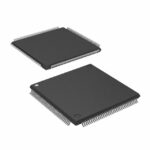 A54SX32A-1TQ144
The activity of extra discounts on wholesale prices is in full swing…
Please fill in your contact information and we will send you the latest wholesale price list.






