 ChipApex | Global Electronic Components Supplier
SEARCH
Search Product
Search Post
— IC芯片 | 连接器 | 传感器 | 被动器件 —
Search productSearch post
— IC芯片 | 连接器 | 传感器 | 被动器件 —
Consult the customer manager about the wholesale price.
consultation hotline:86-132-6715-2157
email:[email protected]
Contact the product manager for consultation. One-stop consultation is available.
Do you want a lower wholesale price? Please send us your inquiry and we will reply immediately.
The A54SX32A-TQ100 is a Field Programmable Gate Array from the SX-A family, manufactured by Microchip Technology. It features 48,000 system gates and 2,880 logic modules. The device supports up to 81 user-programmable I/O pins in a 100-pin Thin Quad Flat Pack (TQFP) package. It operates on a 0.22 μm / 0.25 μm CMOS antifuse process technology with internal performance reaching 350 MHz. The standard speed grade provides deterministic timing suitable for high-performance designs.
Verify the specific temperature grade suffix required for the application environment, as the base model designation does not specify commercial, industrial, automotive, or military ranges. Confirm RoHS compliance status if lead-free packaging is mandated for the manufacturing process. Check for end-of-life notifications or discontinuation notices prior to finalizing procurement plans.
Select this component when 48,000 system gates and 2,880 logic modules are sufficient for the design complexity. Ensure the 100-pin TQFP package fits the PCB layout constraints. Verify that the standard speed grade meets the maximum system clock requirements, noting that faster grades like -1 or -2 offer approximately 15% and 25% improvements respectively.
This part belongs to the Actel SX-A family of FPGAs, which are fabricated using antifuse technology. The family includes devices ranging from 12,000 to 108,000 system gates. The A54SX32A variant specifically offers a balance of capacity and pin count, making it suitable for mid-range applications within the broader SX-A portfolio.
Direct replacements include other speed grades of the same package such as A54SX32A-1TQ100 or A54SX32A-2TQ100 for higher performance. Different temperature grades like A54SX32A-ITQ100 (Industrial) or A54SX32A-ATQ100 (Automotive) serve as functional equivalents with adjusted environmental ratings.
In Flexible mode, TDI, TCK, and DDO function as user I/Os upon power-up. An external 10 kΩ pull-up resistor should be placed on the TMS pin to ensure it defaults to High.
No, the HCLK pin must be set to Low or High on the board if not used. Leaving it floating can cause false output levels due to slow power-on-reset signals.
Reverse engineering is prevented because it is difficult to distinguish between programmed and unprogrammed antifuses. Additionally, FuseLock technology hides security fuses throughout the fabric to prevent internal probing and overwriting.

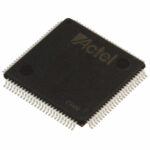 A54SX32A-TQ100
The activity of extra discounts on wholesale prices is in full swing…
Please fill in your contact information and we will send you the latest wholesale price list.




