 ChipApex | Global Electronic Components Supplier
SEARCH
Search Product
Search Post
— IC芯片 | 连接器 | 传感器 | 被动器件 —
Search productSearch post
— IC芯片 | 连接器 | 传感器 | 被动器件 —
Consult the customer manager about the wholesale price.
consultation hotline:86-132-6715-2157
email:[email protected]
Contact the product manager for consultation. One-stop consultation is available.
Do you want a lower wholesale price? Please send us your inquiry and we will reply immediately.
The MACOM A66-3 is a general-purpose RF amplifier operating from 5 MHz to 1.1 GHz. It provides a gain of 26 dB with a noise figure of 3 dB. The device requires a 5 V supply and draws 16 mA. Key linearity metrics include a P1dB of 3 dBm and an OIP3 of 13 dBm. It utilizes Silicon technology in a TO-8-4 package for through-hole mounting. The component functions within a temperature range of -40°C to +125°C.
Verify the specific ordering suffix against the manufacturer's official documentation to ensure correct pinout and electrical characteristics. Confirm that the TO-8-4 through-hole package aligns with the target PCB layout requirements. Cross-reference the RoHS compliance status using the latest datasheet revision. Ensure the supplier provides traceability documentation for the silicon-based component. Validate the active product status directly with MACOM Technology Solutions before finalizing procurement orders.
Select this component when a low-noise, moderate-gain amplifier is required for frequencies up to 1.1 GHz. The 3 dB noise figure makes it suitable for sensitive front-end stages. Consider the 3 dBm P1dB limit for linear signal handling. The TO-8-4 package dictates specific mechanical integration constraints. Compare against the A66-1 if higher output power or different voltage ranges are necessary for the specific application design.
The A66-3 belongs to the A66 series of RF amplifiers manufactured by MACOM Technology Solutions. This series employs discrete hybrid construction techniques to achieve stable performance across wide bandwidths. The family targets applications requiring reliable amplification in industrial and scientific environments. MACOM leverages its expertise in thin-film processes to maintain consistency in these silicon-based components.
The A66-1 is a documented variant within the same series offering higher gain and output power but requiring different biasing conditions. Verify compatibility regarding supply voltage and current consumption when substituting. Ensure the replacement maintains the required frequency range and package footprint.
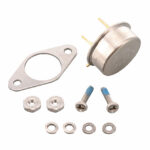 A66-3
A66-3
The activity of extra discounts on wholesale prices is in full swing…
Please fill in your contact information and we will send you the latest wholesale price list.





