 ChipApex | Global Electronic Components Supplier
SEARCH
Search Product
Search Post
— IC芯片 | 连接器 | 传感器 | 被动器件 —
Search productSearch post
— IC芯片 | 连接器 | 传感器 | 被动器件 —
Consult the customer manager about the wholesale price.
consultation hotline:86-132-6715-2157
email:[email protected]
Contact the product manager for consultation. One-stop consultation is available.
Do you want a lower wholesale price? Please send us your inquiry and we will reply immediately.
The A6727TR is a single-phase step-down switching controller from STMicroelectronics, designed for automotive applications. It operates with a fixed internal oscillator frequency of 300 kHz and supports an adjustable output voltage with ±1% accuracy. The device features a flexible power supply range of 5 V to 12 V and accepts power input as low as 1.5 V. It utilizes a compact SO-8 package and includes integrated high-current drivers. Key protection mechanisms include programmable overcurrent protection via low-side MOSFET RDS(on) monitoring, overvoltage/undervoltage protection, and FB disconnection protection.
Verify component status carefully as the A6727 series may be designated as Not Recommended for New Designs (NRND). Confirm that the TR suffix corresponds to the required reel packaging format for your assembly line. Ensure compatibility with AEC-Q100 qualification requirements if deploying in automotive environments. Cross-reference datasheet revisions to confirm feature consistency before finalizing procurement orders.
Select this controller for applications requiring a simple voltage mode control loop with high integration. It is suitable where minimizing external sense resistors is critical for cost and space reduction. Consider the 300 kHz fixed frequency for EMI management and component sizing. Verify that the 8-SOIC package fits the thermal and spatial constraints of the target PCB layout.
The A6727 belongs to STMicroelectronics' portfolio of single-phase PWM controllers. It shares architectural similarities with the L6726A but differs in oscillator frequency and specific protection implementations. Both devices utilize the SO-8 package and target similar DC-DC conversion needs, though the A6727 offers distinct timing characteristics and driver capabilities tailored for specific automotive and industrial power management scenarios.
The L6726A is a related single-phase step-down controller from the same manufacturer. While it shares the SO-8 package and basic buck topology, it operates at a fixed 270 kHz frequency. Engineers must evaluate differences in error amplifier type and protection logic when substituting between these models.
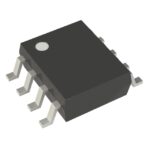 A6727TR
The activity of extra discounts on wholesale prices is in full swing…
Please fill in your contact information and we will send you the latest wholesale price list.





