 ChipApex | Global Electronic Components Supplier
SEARCH
Search Product
Search Post
— IC芯片 | 连接器 | 传感器 | 被动器件 —
Search productSearch post
— IC芯片 | 连接器 | 传感器 | 被动器件 —
Consult the customer manager about the wholesale price.
consultation hotline:86-132-6715-2157
email:[email protected]
Contact the product manager for consultation. One-stop consultation is available.
Do you want a lower wholesale price? Please send us your inquiry and we will reply immediately.
The ACPL-772L-520E is a high-speed CMOS optocoupler manufactured by Broadcom Limited. It features a single channel with push-pull output configuration, supporting a data rate of 25 MBd and a maximum pulse width distortion of 6 ns. The device operates within a supply voltage range of 3.3V to 5V and provides an isolation voltage of 5000 Vrms. Key timing parameters include rise and fall times of 9 ns and 8 ns respectively, with a propagation delay specified at 6 ns. It delivers an output current of 10 mA per channel and dissipates up to 150 mW of power. The component functions reliably across an operating temperature range from -40°C to +105°C.
Verify the specific suffix '520' against official Broadcom documentation to confirm package type and tape/reel specifications. Ensure compatibility with existing PCB footprints, as packaging variations exist within the ACPL-772L series. Confirm that the required isolation voltage and data rate meet system safety and performance standards before finalizing procurement decisions.
Select this component when high-speed data transfer is critical alongside strong electrical isolation. The push-pull output architecture supports direct driving of logic inputs without additional buffering. Consider the thermal dissipation limits and operating temperature range to ensure reliability in demanding environments. Verify that the 25 MBd speed meets the application's bandwidth requirements compared to slower alternatives.
This device belongs to the ACPL-772L series of high-speed optocouplers designed for demanding digital isolation applications. The series utilizes CMOS technology to achieve fast switching speeds while maintaining low power consumption. Broadcom integrates advanced LED and photodetector technologies within the package to ensure consistent performance across the specified temperature range.
Cross-reference part numbers such as ACPL-772L-020E for alternative packaging options within the same functional family. Verify pinout compatibility and electrical parameter equivalence before substitution. Consult official replacement guides to ensure no changes in isolation ratings or data rates occur during component swaps.
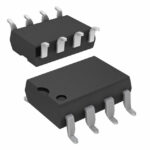 ACPL-772L-520E
The activity of extra discounts on wholesale prices is in full swing…
Please fill in your contact information and we will send you the latest wholesale price list.




