 ChipApex | Global Electronic Components Supplier
SEARCH
Search Product
Search Post
— IC芯片 | 连接器 | 传感器 | 被动器件 —
Search productSearch post
— IC芯片 | 连接器 | 传感器 | 被动器件 —
Consult the customer manager about the wholesale price.
consultation hotline:86-132-6715-2157
email:[email protected]
Contact the product manager for consultation. One-stop consultation is available.
Do you want a lower wholesale price? Please send us your inquiry and we will reply immediately.
The ACSL-6310-50TE is a high-speed optocoupler from the Broadcom ACSL series, featuring three independent channels in a 16-pin SOIC-Narrow package. It supports data rates up to 15 MBd with an isolation voltage of 2500 Vrms. The device operates within a supply voltage range of 3.0V to 5.5V and utilizes open collector outputs capable of handling 50 mA output current. Key electrical parameters include a forward current of 10 mA, forward voltage of 1.52 V, reverse voltage of 5 V, and power dissipation of 40 mW. Timing characteristics specify a rise time of 35 ns and a fall time of 12 ns, ensuring rapid signal transmission for demanding applications.
Verify component authenticity by checking manufacturer markings against official datasheet specifications. Confirm RoHS compliance status through provided documentation. Ensure storage conditions maintain integrity prior to assembly. Cross-reference ordering suffixes to confirm tape-and-reel packaging requirements. Validate pinout configuration matches the 16-SOIC-Narrow footprint before integration into design.
Select this component when three-channel isolation is required alongside high-speed data transmission capabilities. Consider the 2500 Vrms isolation rating for safety-critical applications. Evaluate the 15 MBd data rate against system bandwidth requirements. Assess thermal management needs based on the 40 mW power dissipation specification. Ensure compatibility with 3.0V to 5.5V logic levels for seamless interface integration.
This part belongs to the Broadcom ACSL family of high-speed optocouplers designed for robust performance in noisy environments. The ACSL series emphasizes fast switching speeds and reliable isolation for modern electronic systems. The specific model integrates three channels to reduce board space compared to single-channel alternatives. It serves as a critical interface component bridging disparate voltage domains in complex circuit architectures.
Direct substitutes may include other Broadcom ACSL series variants with matching channel counts and speed ratings. Verify pinout compatibility and isolation voltage ratings when considering alternative manufacturers. Ensure equivalent timing parameters are met to maintain system signal integrity during replacement scenarios.
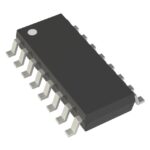 ACSL-6310-50TE
The activity of extra discounts on wholesale prices is in full swing…
Please fill in your contact information and we will send you the latest wholesale price list.





