 ChipApex | Global Electronic Components Supplier
SEARCH
Search Product
Search Post
— IC芯片 | 连接器 | 传感器 | 被动器件 —
Search productSearch post
— IC芯片 | 连接器 | 传感器 | 被动器件 —
Consult the customer manager about the wholesale price.
consultation hotline:86-132-6715-2157
email:[email protected]
Contact the product manager for consultation. One-stop consultation is available.
Do you want a lower wholesale price? Please send us your inquiry and we will reply immediately.
The Broadcom ACSL-7210-50RE is a high-speed, dual-channel logic output optocoupler housed in an 8-SOIC surface-mount package. It features a push-pull output configuration with a data rate of 25 MBd and isolation voltage of 3750 Vrms. Key electrical parameters include a maximum propagation delay of 40 ns for both rise and fall transitions, typical rise/fall times of 5.1 ns/3.8 ns, and a minimum common-mode transient immunity of 25 kV/µs. The device supports supply voltages of 3V–3.6V or 4.5V–5.5V, operates within a -40°C to 105°C temperature range, and provides 10 mA output current per channel.
Verify the specific suffix '50RE' corresponds to the required RoHS compliance and tape-and-reel packaging format. Confirm that the 8-SOIC footprint matches the target PCB design constraints. Ensure the selected component meets the necessary insulation voltage ratings for the intended application safety standards. Cross-reference the manufacturer's latest datasheet revision to confirm active status and any potential form-fit-function changes.
Select this component when high-speed data integrity and strong noise immunity are critical requirements. The push-pull output architecture is preferred over open-collector types for applications demanding faster edge rates and bidirectional drive strength. Consider the 3750 Vrms isolation barrier for safety-critical interfaces between low-voltage logic and higher-voltage power stages. Evaluate thermal performance within the specified -40°C to 105°C operational window.
This part belongs to the Broadcom ACSL-7210 series of high-speed optocouplers. It is designed as a successor or alternative to older logic-output isolators, offering significantly improved speed and noise immunity. The series utilizes advanced LED and photodiode technology to achieve high CMTI while maintaining compact surface-mount packaging for modern electronic assemblies.
Direct replacements may include other 25 MBd dual-channel push-pull optocouplers with similar 3750 Vrms isolation. Verify pinout compatibility and electrical parameter margins before substitution. Check for equivalent common-mode transient immunity ratings to ensure noise performance is maintained.
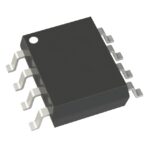 ACSL-7210-50RE
The activity of extra discounts on wholesale prices is in full swing…
Please fill in your contact information and we will send you the latest wholesale price list.






