 ChipApex | Global Electronic Components Supplier
SEARCH
Search Product
Search Post
— IC芯片 | 连接器 | 传感器 | 被动器件 —
Search productSearch post
— IC芯片 | 连接器 | 传感器 | 被动器件 —
Consult the customer manager about the wholesale price.
consultation hotline:86-132-6715-2157
email:[email protected]
Contact the product manager for consultation. One-stop consultation is available.
Do you want a lower wholesale price? Please send us your inquiry and we will reply immediately.
The ACST12-7SG is a transient protected AC power switch from the ACS/ACST family, utilizing ASD technology. It integrates a Triac structure with an overvoltage crowbar device to absorb inductive turn-off energy and withstand line transients per IEC 61000-4-5 standards. Rated for 12 A RMS current and 700 V blocking voltage, this specific variant features low gate triggering current (IGT < 10 mA) for easy MCU interfacing while maintaining high noise immunity compliant with IEC 61000-4-4. The component is housed in a D²PAK package.
Verify the ordering code matches ACST12-7SG to confirm the D²PAK package and low gate sensitivity. Ensure the application design accounts for the specified thermal characteristics and junction temperature limits during operation. Confirm compliance with environmental requirements such as ECOPACK specifications if applicable.
Select this component when driving medium power AC loads up to 12 A that require robust transient protection. The low gate trigger current makes it suitable for direct microcontroller interface without additional driver circuitry. Consider the D²PAK package for surface mount applications requiring efficient heat dissipation.
This part belongs to the ACST12 series within STMicroelectronics' ACS/ACST power switch family. These devices are built using Application Specific Discrete (ASD) technology, designed specifically for home appliances and industrial systems. The series offers various packages and sensitivities to suit different load and control requirements.
Direct substitutes include other variants within the ACST12 series, such as ACST12-7CT or ACST12-7ST, provided the package type and gate sensitivity match the design requirements. Verify thermal performance and pinout compatibility before substitution.
The typical clamping voltage (VCL) is 850 V at 25 °C junction temperature.
It uses an overvoltage crowbar technology to clamp low-energy spikes or switch to the on state to dissipate higher energy shocks, recovering its blocking capability afterward.
Yes, the device is designed to withstand line transients described in the IEC 61000-4-5 standard, enabling equipment compliance.
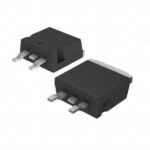 ACST12-7SG
The activity of extra discounts on wholesale prices is in full swing…
Please fill in your contact information and we will send you the latest wholesale price list.





