 ChipApex | Global Electronic Components Supplier
SEARCH
Search Product
Search Post
— IC芯片 | 连接器 | 传感器 | 被动器件 —
Search productSearch post
— IC芯片 | 连接器 | 传感器 | 被动器件 —
Consult the customer manager about the wholesale price.
consultation hotline:86-132-6715-2157
email:[email protected]
Contact the product manager for consultation. One-stop consultation is available.
Do you want a lower wholesale price? Please send us your inquiry and we will reply immediately.
The AD1674AR is a monolithic 12-bit, 100 kSPS analog-to-digital converter (ADC) manufactured by Analog Devices Inc. It integrates a sample-and-hold amplifier (SHA), a 10 V reference, and three-state output buffers. The device supports unipolar (0–10 V, 0–20 V) and bipolar (±5 V, ±10 V) input ranges with an internal reference voltage of 10 V. It operates on +5 V logic and ±12 V to ±15 V analog supplies. The AD1674AR features industry-standard pinout compatibility with the AD574A and AD674A, ensuring direct replacement in existing designs while offering faster conversion rates.
Verify the specific suffix 'AR' corresponds to the Plastic SOIC package and -40°C to +85°C temperature grade as defined in the ordering guide. Confirm power supply requirements match the specified VCC (+11.4V to +16.5V) and VEE (-16.5V to -11.4V) ranges. Ensure ESD precautions are observed during handling due to the sensitivity of the BiMOS II process technology.
Select the AD1674AR when system design requires compatibility with legacy AD574A/AD674A footprints but demands improved performance through integrated SHA and AC specifications. Choose this model for applications needing calibrated unipolar/bipolar ranges without external scaling resistors. Consider the -40°C to +85°C operating range suitability for commercial and industrial environments compared to military grades.
The AD1674 series utilizes Analog Devices’ BiMOS II process, combining high-performance bipolar analog circuitry with digital CMOS logic. This architecture enables the integration of precision laser-trimmed resistors and offset calibration circuits on a single die. The device family includes multiple temperature grades and package options, with the AR variant specifically designated for plastic surface-mount applications within the extended commercial temperature range.
The AD1674AR is pin-compatible with the AD574A and AD674A. When replacing these older components, verify that the host system can accommodate the slightly different control logic timing and power supply configurations. No functional changes are required for basic data acquisition tasks, but AC performance improvements should be leveraged in signal processing designs.
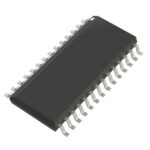 AD1674AR
The activity of extra discounts on wholesale prices is in full swing…
Please fill in your contact information and we will send you the latest wholesale price list.





