 ChipApex | Global Electronic Components Supplier
SEARCH
Search Product
Search Post
— IC芯片 | 连接器 | 传感器 | 被动器件 —
Search productSearch post
— IC芯片 | 连接器 | 传感器 | 被动器件 —
Consult the customer manager about the wholesale price.
consultation hotline:86-132-6715-2157
email:[email protected]
Contact the product manager for consultation. One-stop consultation is available.
Do you want a lower wholesale price? Please send us your inquiry and we will reply immediately.
The AD1859JR is a stereo, single-supply 18-bit integrated SD DAC from Analog Devices. It operates on a single +5 V supply and features a variable rate digital interpolation filter, multibit sigma-delta modulator with dither, and jitter-tolerant DAC architecture. The device includes an on-chip digital PLL for asynchronous master clocking, rejecting sample clock jitter by 6 dB per octave above and below 15 Hz. Key electrical specifications include a dynamic range of 94 dB (A-weighted), –88 dB THD+N, and buffered analog outputs capable of driving a 2 kΩ load. It supports continuously variable sample rates and offers flexible serial data input modes.
The AD1859JR is designated as obsolete by Analog Devices. Verification of current availability requires checking authorized distributors or surplus suppliers, as standard manufacturing channels no longer support this part number. Ensure compliance with RoHS directives if required by the target application, noting that older obsolete parts may not meet current environmental standards.
Select the AD1859JR when a complete stereo DAC subsystem with integrated oversampling and jitter rejection is required. It is suitable for designs needing asynchronous master clock operation without high-frequency synchronous clocks. Consider the 28-pin SOIC package (R-28) for surface mount assembly. Verify compatibility with 16-bit or 18-bit two's complement serial data formats and ensure the system can provide the necessary +5 V single supply.
The AD1859JR belongs to the AD1859 family of audio DACs, which are designed for high-performance digital audio playback. The 'JR' suffix indicates the -40°C to +105°C industrial temperature range and the 28-Lead SOIC package. This component integrates functions typically requiring multiple discrete chips, including the DAC, interpolation filter, and analog output drivers, into a single monolithic CMOS die.
As the AD1859JR is obsolete, direct replacements must be sourced from surplus inventory or evaluated for pin-to-pin and functional compatibility. Potential alternatives should offer similar 18-bit resolution, stereo output, and +5 V operation. Verify that substitute devices support the same serial interface protocols (I2S, DSP mode) and jitter rejection characteristics to maintain system performance.
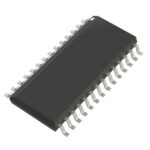 AD1859JR
The activity of extra discounts on wholesale prices is in full swing…
Please fill in your contact information and we will send you the latest wholesale price list.







