 ChipApex | Global Electronic Components Supplier
SEARCH
Search Product
Search Post
— IC芯片 | 连接器 | 传感器 | 被动器件 —
Search productSearch post
— IC芯片 | 连接器 | 传感器 | 被动器件 —
Consult the customer manager about the wholesale price.
consultation hotline:86-132-6715-2157
email:[email protected]
Contact the product manager for consultation. One-stop consultation is available.
Do you want a lower wholesale price? Please send us your inquiry and we will reply immediately.
The AD1877JRZ-RL is a stereo, 16-bit oversampling analog-to-digital converter (ADC) based on Sigma-Delta technology. It operates from a single 5 V power supply and features two single-ended analog inputs with an internal voltage reference. The device integrates a fourth-order modulator and a three-stage linear-phase decimation filter, achieving a typical dynamic range of 92 dB and signal-to-noise ratio of 90 dB. It accepts input clocks of 256×FS or 384×FS and provides a flexible serial output interface compatible with I2S formats.
Verify the specific ordering suffix for reel packaging when sourcing the AD1877JRZ-RL variant. Confirm that the component meets RoHS compliance standards as indicated in official documentation. Ensure that ESD precautions are observed during handling due to the sensitivity of the CMOS process. Check for availability through authorized distributors as stock levels may vary.
Select this component for applications requiring high-fidelity audio conversion with a single 5 V supply. Ensure the system clock can provide 256×FS or 384×FS frequencies relative to the desired sampling rate. Verify that the input signals are AC coupled to allow proper autocalibration of DC offsets. Consider the 28-lead SOIC package constraints for PCB layout and thermal management.
The AD1877 is part of Analog Devices' audio ADC portfolio designed for digital audio bandwidth applications. It utilizes a proprietary differential switched-capacitor architecture to minimize idle tones and ensure monotonicity. The device is fabricated using a 0.8 µm CMOS double polysilicon, double metal process, offering robust performance in consumer electronics.
No direct public substitute part numbers are confirmed in the provided documentation. Evaluate alternative ADCs based on pin compatibility, resolution, and supply voltage requirements if replacement is necessary.
The AD1877 uses on-chip automatic offset calibration that occurs immediately after reset. This procedure nulls out offsets in the single-to-differential converter, analog modulator, and decimation filter, assuming the inputs are AC coupled.
The group delay is determined by the digital decimation filter and is calculated as 36/FS seconds. For common sample rates, this is approximately 750 µs at 48 kHz, 816 µs at 44.1 kHz, and 1125 µs at 32 kHz.
Yes, the AD1877 supports both serial port master and slave modes. In master mode, serial interface clocks are internally derived from CLKIN. In slave mode, all clocks must be externally derived from a common source.
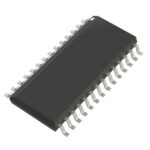 AD1877JRZ-RL
The activity of extra discounts on wholesale prices is in full swing…
Please fill in your contact information and we will send you the latest wholesale price list.





