 ChipApex | Global Electronic Components Supplier
SEARCH
Search Product
Search Post
— IC芯片 | 连接器 | 传感器 | 被动器件 —
Search productSearch post
— IC芯片 | 连接器 | 传感器 | 被动器件 —
Consult the customer manager about the wholesale price.
consultation hotline:86-132-6715-2157
email:[email protected]
Contact the product manager for consultation. One-stop consultation is available.
Do you want a lower wholesale price? Please send us your inquiry and we will reply immediately.
The AD1941YSTZ-29 is a 16-channel digital audio processor from Analog Devices, part of the SigmaDSP family. It features a 28-bit × 28-bit multiplier with a full 56-bit accumulator for double-precision processing. The device accepts sample rates up to 192 kHz and includes 21 kB of data memory for audio delay. It operates on a single 2.5 V supply, utilizing an on-chip voltage regulator for compatibility with 3.3 V or 5 V systems. The AD1941 is distinguished by its 2-wire I²C control interface, contrasting with the SPI interface of the AD1940. It is housed in a 48-lead LQFP package.
Verify the specific ordering suffix against the manufacturer's current datasheet to confirm pinout and electrical specifications. The AD1941 variant utilizes an I²C interface, which differs from the SPI interface found on the AD1940. Ensure that the control logic in the host system supports the required I²C protocol and addressing schemes defined in the technical documentation.
Select the AD1941 over the AD1940 when an I²C control interface is preferred or required by the system architecture. Both devices share identical signal processing capabilities, including the 56-bit DSP core and 16-channel I/O. Consider the available serial data formats, such as I²S, left-justified, right-justified, and TDM modes, to ensure compatibility with connected ADCs and DACs.
The AD1941 is functionally identical to the AD1940 except for the control interface. While the AD1940 uses a 4-wire SPI port, the AD1941 employs a 2-wire I²C bus. This distinction affects the pin configuration, specifically replacing the SPI pins (CDATA, CCLK, CLATCH, COUT) with I²C pins (SDA, SCL) and adding an I²C filter enable pin. The core DSP engine, memory sizes, and audio performance remain unchanged between the two parts.
The AD1940 is a direct functional substitute if the system design allows for adapting the control interface from I²C to SPI. Verify that the host microcontroller has the necessary SPI hardware resources available. Pin compatibility must be checked, as the control pins differ significantly between the two variants.
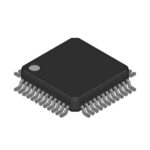 AD1941YSTZ-29
The activity of extra discounts on wholesale prices is in full swing…
Please fill in your contact information and we will send you the latest wholesale price list.





