 ChipApex | Global Electronic Components Supplier

SEARCH
Search Product
Search Post
— IC芯片 | 连接器 | 传感器 | 被动器件 —
Search productSearch post
— IC芯片 | 连接器 | 传感器 | 被动器件 —
Consult the customer manager about the wholesale price.
consultation hotline:86-132-6715-2157
email:[email protected]
Contact the product manager for consultation. One-stop consultation is available.
Do you want a lower wholesale price? Please send us your inquiry and we will reply immediately.
The AD261AND-2 is a high-speed digital isolator designed to isolate five digital control signals between a microcontroller and field I/O components. It features a 20 MHz minimum logic signal bandwidth and a propagation delay of 14 ns. The device provides an isolation test voltage up to 3.5 kV rms and a common-mode transient immunity (CMTI) of 10 kV/µs min. It operates within a supply voltage range of 4 V to 5.75 V and supports output enable/three-state functions via two dedicated pins. The component is housed in a 22-DIP package.
Verify the specific suffix against official Analog Devices documentation to confirm pinout and electrical characteristics, as variations exist within the family. Confirm that the 22-DIP package matches the target PCB footprint requirements. Ensure the design accounts for the specified 4 V to 5.75 V supply range and thermal dissipation limits during operation.
Select this component when replacing multiple opto-isolators to reduce board space and improve switching speed. It is suitable for applications requiring precise timing isolation, such as PWM control, due to its low propagation delay and edge symmetry. Consider the 3.5 kV rms isolation rating for safety compliance in industrial environments.
The AD261 series replaces discrete opto-isolator solutions by integrating five isolated channels into a single module. This consolidation simplifies circuit design and improves reliability. The AD261AND-2 variant specifically utilizes a 22-pin DIP configuration, offering a legacy-compatible form factor for retrofitting or maintaining existing industrial control architectures.
Direct substitutes include other models from the AD261 family, such as the AD261AN, which offer different I/O configurations. Verify that any replacement maintains the required 20 MHz bandwidth and 3.5 kVrms isolation voltage to ensure functional equivalence in high-speed isolation applications.
It maintains output waveform symmetry within ±1 ns of the input, allowing it to accurately isolate time-based PWM signals without distortion.
The two enable pins allow all field or system output pins to be set to a high-resistance three-state level, facilitating easy multiplexing and presetting logic levels at power-up.
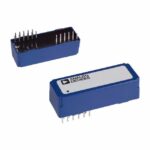 AD261AND-2

The activity of extra discounts on wholesale prices is in full swing…
Please fill in your contact information and we will send you the latest wholesale price list.





