 ChipApex | Global Electronic Components Supplier

SEARCH
Search Product
Search Post
— IC芯片 | 连接器 | 传感器 | 被动器件 —
Search productSearch post
— IC芯片 | 连接器 | 传感器 | 被动器件 —
Consult the customer manager about the wholesale price.
consultation hotline:86-132-6715-2157
email:[email protected]
Contact the product manager for consultation. One-stop consultation is available.
Do you want a lower wholesale price? Please send us your inquiry and we will reply immediately.
The AD261AND-4 is a general-purpose digital isolator manufactured by Analog Devices Inc. It features five channels of isolation with unidirectional signal transmission capability. The device utilizes magnetic coupling technology to achieve an insulation voltage rating of 1750 Vrms and a common mode transient immunity of 10 kV/µs. It operates within a supply voltage range of 1.7 V to 5.5 V, drawing a typical operating current of 17.3 mA. The component supports data rates up to 150 Mb/s with a propagation delay of 7.2 ns. It is housed in a 22-DIP module package and functions reliably across an extended temperature range from -40°C to +125°C.
Verify the specific suffix (AND-4) against official Analog Devices documentation to confirm pinout and package configuration. Ensure compatibility with system voltage requirements and thermal management needs. Confirm availability status as distribution channels may report limited stock or restricted supply conditions. Validate that the 22-DIP module form factor fits the target PCB layout constraints.
Select this component when five isolated channels are required for bidirectional or unidirectional control signals. Consider the 1750 Vrms isolation rating for safety compliance in low-to-medium voltage applications. Evaluate the 10 kV/µs CMTI specification for suitability in high-noise industrial settings. Compare power consumption and package size against alternative isolators if space or energy efficiency is critical.
The AD261 series is designed specifically for isolating digital control signals in microcontroller-based systems. The AND-4 variant denotes a specific package and configuration within this family. Analog Devices integrates magnetic coupling technology to provide reliable isolation without optical degradation over time. This series targets applications requiring robust signal integrity between isolated domains.
The AD261AND-4 has an insulation voltage rating of 1750 Vrms.
The device provides five channels of digital isolation.
It uses magnetic coupling technology for signal transmission across the isolation barrier.
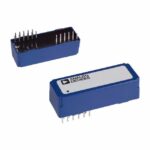 AD261AND-4

The activity of extra discounts on wholesale prices is in full swing…
Please fill in your contact information and we will send you the latest wholesale price list.





