 ChipApex | Global Electronic Components Supplier
SEARCH
Search Product
Search Post
— IC芯片 | 连接器 | 传感器 | 被动器件 —
Search productSearch post
— IC芯片 | 连接器 | 传感器 | 被动器件 —
Consult the customer manager about the wholesale price.
consultation hotline:86-132-6715-2157
email:[email protected]
Contact the product manager for consultation. One-stop consultation is available.
Do you want a lower wholesale price? Please send us your inquiry and we will reply immediately.
The AD2S82AHPZ is a monolithic, variable-resolution resolver-to-digital converter manufactured by Analog Devices Inc. It converts analog sine and cosine signals from a resolver into a parallel natural binary digital word using a ratiometric tracking method. The device supports user-selectable resolutions of 10, 12, 14, or 16 bits via SC1 and SC2 pins. It operates with dual power supplies ranging from ±10.8 V to ±13.2 V and a logic supply of +5 V to +V_S. The component is housed in a 44-lead Plastic Leaded Chip Carrier (PLCC) package and provides an analog velocity output proportional to the rate of change of the input angle.
Verify the specific accuracy grade required for the application, as the HP suffix denotes industrial temperature range (-40°C to +85°C) with 22 arc min accuracy. Confirm that the 44-PLCC surface mount package matches the PCB footprint. Check current availability status, as older generation components may have limited stock or end-of-life implications compared to newer integrated solutions.
Select the AD2S82AHPZ when variable resolution and high tracking rates are required. Ensure external components for bandwidth selection (C4, C5, R5) and tracking rate (R6) are chosen according to the reference frequency and desired dynamic response. Verify that the system can accommodate the ±12 V power supplies and that the resolver signal amplitudes remain within 10% of nominal for optimal performance.
The AD2S82AHPZ belongs to the AD2S81A/AD2S82A family of monolithic BiMOS II tracking converters. Unlike the fixed 12-bit AD2S81A, the AD2S82A offers flexible resolution settings and additional features such as a VCO output and data complement facility. The HP suffix specifically indicates the plastic PLCC package and industrial temperature rating, distinguishing it from ceramic DIP or commercial grade variants.
Direct pin-compatible replacements are not explicitly listed in the provided documentation. Consider the AD2S82ALP for lower angular accuracy requirements (2 arc min vs 22 arc min) or different temperature grades if available. For modern designs, evaluate newer single-chip solutions like the AD2S1210 or AD2S90 families which may offer integrated excitation and digital interfaces.
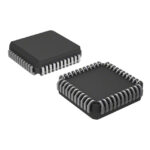 AD2S82AHPZ
The activity of extra discounts on wholesale prices is in full swing…
Please fill in your contact information and we will send you the latest wholesale price list.





