 ChipApex | Global Electronic Components Supplier
SEARCH
Search Product
Search Post
— IC芯片 | 连接器 | 传感器 | 被动器件 —
Search productSearch post
— IC芯片 | 连接器 | 传感器 | 被动器件 —
Consult the customer manager about the wholesale price.
consultation hotline:86-132-6715-2157
email:[email protected]
Contact the product manager for consultation. One-stop consultation is available.
Do you want a lower wholesale price? Please send us your inquiry and we will reply immediately.
The AD2S83IPZ is a monolithic, variable-resolution resolver-to-digital converter (RDC) from Analog Devices. It converts analog sine/cosine resolver signals into parallel natural binary digital words using a ratiometric tracking method. The device supports user-selectable resolutions of 10, 12, 14, or 16 bits via SC1 and SC2 pins. It operates with ±12 V analog supplies and +5 V logic supply, featuring a maximum tracking rate of 1040 rps at 10-bit resolution. The component provides a precise analog velocity output proportional to rotational speed and includes 3-state parallel data outputs compatible with 8- or 16-bit buses.
Verify the specific suffix IPZ corresponds to the Industrial temperature range (-40°C to +85°C) and Plastic Leaded Chip Carrier package. Confirm current availability status as distribution channels may report limited stock or discontinuation for legacy RDC models. Ensure ESD precautions are observed during handling due to the sensitivity of the CMOS/BiCMOS internal circuitry.
Select external components R4, R6, C4, and C5 to define the closed-loop bandwidth and maximum tracking rate according to system requirements. Higher resolutions (14/16-bit) inherently reduce the maximum allowable tracking rate compared to 10-bit mode. Ensure reference frequency remains within 0 Hz to 20,000 Hz and signal amplitudes are maintained near 2 V rms for optimal linearity.
The AD2S83 series includes variants such as the AD2S83AP and AD2S83IP, differentiated primarily by accuracy specifications and temperature ranges. The IPZ variant denotes the industrial grade version housed in a 44-lead PLCC package. It belongs to the family of analog tracking RDCs designed for high-reliability motion control applications before the widespread adoption of digital serial interfaces.
Direct pin-compatible replacements are limited due to the proprietary tracking architecture. Modern alternatives often involve digital RDCs with SPI/I2C interfaces (e.g., AD2S1210), which require significant schematic and firmware redesign. Verify if the target application can accommodate the transition from parallel analog/digital hybrid interfaces to serial digital protocols.
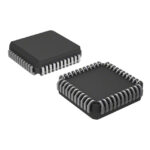 AD2S83IPZ
The activity of extra discounts on wholesale prices is in full swing…
Please fill in your contact information and we will send you the latest wholesale price list.





