 ChipApex | Global Electronic Components Supplier
SEARCH
Search Product
Search Post
— IC芯片 | 连接器 | 传感器 | 被动器件 —
Search productSearch post
— IC芯片 | 连接器 | 传感器 | 被动器件 —
Consult the customer manager about the wholesale price.
consultation hotline:86-132-6715-2157
email:[email protected]
Contact the product manager for consultation. One-stop consultation is available.
Do you want a lower wholesale price? Please send us your inquiry and we will reply immediately.
The AD421BR is a loop-powered, 16-bit digital-to-analog converter (DAC) designed for industrial control smart transmitters. It converts serial digital data into a 4 mA to 20 mA current output with 16-bit monotonicity and ±0.01% integral nonlinearity. The device integrates a selectable voltage regulator providing +3 V, +3.3 V, or +5 V outputs, alongside precision +1.25 V and +2.5 V reference buffers. Operating from a supply range of +2.95 V to +5.05 V, it features a high-speed serial interface supporting up to 10 Mbps and includes programmable alarm current capabilities. The component is housed in a 16-lead SOIC package and specified for temperatures between –40 °C and +85 °C.
Verify the specific package variant, as the 'BR' suffix denotes the 16-lead SOIC option. Confirm that external components, including a depletion-mode FET pass transistor and filtering capacitors, are included in the system design, as these are required for proper regulator operation and stability. Ensure the host microcontroller interface matches the required serial timing specifications.
Select the AD421BR when a fully integrated, low-cost solution for extending transmitter resolution is required. The choice of the SOIC package is suitable for surface-mount assembly. Designers must account for the external pass transistor requirements to handle loop voltages exceeding the internal regulator limits. Verify that the application does not require shutdown modes, as this device lacks a dedicated shutdown pin.
The AD421 series serves as a complete solution for generating analog current signals from digital inputs in process control environments. The BR variant specifically refers to the plastic SOIC package version, distinct from the PDIP DIP package (BN). It eliminates the need for discrete regulators and external voltage references by integrating these functions on-chip, simplifying the bill of materials for smart transmitter designs.
The AD5421 is a documented successor in the product line offering similar loop-powered functionality. Direct pin-for-pin replacement may require verification of interface compatibility and external component adjustments.
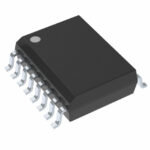 AD421BR
The activity of extra discounts on wholesale prices is in full swing…
Please fill in your contact information and we will send you the latest wholesale price list.





