 ChipApex | Global Electronic Components Supplier
SEARCH
Search Product
Search Post
— IC芯片 | 连接器 | 传感器 | 被动器件 —
Search productSearch post
— IC芯片 | 连接器 | 传感器 | 被动器件 —
Consult the customer manager about the wholesale price.
consultation hotline:86-132-6715-2157
email:[email protected]
Contact the product manager for consultation. One-stop consultation is available.
Do you want a lower wholesale price? Please send us your inquiry and we will reply immediately.
The AD5122BRUZ10 is a dual-channel, nonvolatile digital potentiometer featuring 128 tap positions and an SPI-compatible interface. It offers a nominal resistance of 10 kΩ with ±8% tolerance and a temperature coefficient of 35 ppm/°C. The device supports single (2.3 V to 5.5 V) or dual supply operation (±2.25 V to ±2.75 V) with a separate logic supply range of 1.8 V to 5.5 V. Key electrical characteristics include a maximum wiper current of ±6 mA for the 10 kΩ variant, a bandwidth of 3 MHz, and fast start-up time under 75 µs. It is housed in a 16-lead TSSOP package.
Verify the specific suffix 'BRUZ10' against the manufacturer's ordering guide to confirm the 10 kΩ resistance value and TSSOP package type. Ensure compatibility with the required SPI clock speeds and voltage levels for the target application environment.
Select this component when dual-channel adjustment with persistent settings is required. The 10 kΩ resistance option provides a 3 MHz bandwidth suitable for AC signal processing. Verify that the system voltage falls within the 2.3 V to 5.5 V range for analog supplies and 1.8 V to 5.5 V for logic.
This part belongs to the AD5122/AD5142 family of dual-channel digital potentiometers. The AD5122 variant specifically provides 128 tap positions, whereas the AD5142 offers 256 positions. Both share similar electrical characteristics but differ in resolution and nonlinearity specifications.
The AD5122BRUZ10-RL7 is a parameter-equivalent reel-and-strip version of the same component. Other family members like the AD5142 offer higher resolution (256 taps) but may have different nonlinearity specs.
For the 10 kΩ resistance option, the maximum continuous current is ±6 mA. For the 100 kΩ option, it is ±1.5 mA.
The INDEP pin enables the linear gain setting mode at power-up, allowing each string resistor to be loaded independently from its associated memory location. This setting cannot be disabled by software once enabled.
The data retention is guaranteed for 50 years after 1,000 write cycles. After 100,000 write cycles, the equivalent retention lifetime is approximately 5 years.
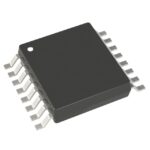 AD5122BRUZ10
The activity of extra discounts on wholesale prices is in full swing…
Please fill in your contact information and we will send you the latest wholesale price list.





