 ChipApex | Global Electronic Components Supplier
SEARCH
Search Product
Search Post
— IC芯片 | 连接器 | 传感器 | 被动器件 —
Search productSearch post
— IC芯片 | 连接器 | 传感器 | 被动器件 —
Consult the customer manager about the wholesale price.
consultation hotline:86-132-6715-2157
email:[email protected]
Contact the product manager for consultation. One-stop consultation is available.
Do you want a lower wholesale price? Please send us your inquiry and we will reply immediately.
The AD5144BCPZ10-RL7 is a quad-channel, nonvolatile digital potentiometer featuring 256 tap positions and an SPI interface. It offers a nominal resistance of 10 kΩ with ±8% tolerance and a temperature coefficient of 35 ppm/°C. The device supports single or dual supply operation (VDD: 2.3 V to 5.5 V; VSS: −2.75 V to +2.75 V) and includes independent logic supply (VLOGIC: 1.8 V to 5.5 V). Key electrical parameters include a maximum wiper current of ±6 mA for the 10 kΩ variant, a bandwidth of 3 MHz, and fast start-up time under 75 µs.
Verify the package type matches the required footprint, as the AD5144 family is available in both 20-lead TSSOP and 24-lead LFCSP packages. Confirm that the specific ordering suffix corresponds to the desired interface and resistance value. Ensure compliance with RoHS standards and check for any specific environmental certifications required by the target application.
Select this model when a quad-channel configuration with SPI control is required. The 10 kΩ resistance option provides higher current handling capability (±6 mA) compared to the 100 kΩ variant. Consider the linear gain setting mode if precise resistance matching between terminals is necessary for the circuit design.
This component belongs to the AD5124/AD5144/AD5144A family of nonvolatile digital potentiometers. The AD5144 specifically denotes the quad-channel version with 256 positions and SPI/I2C compatibility. The 'BCPZ' suffix indicates the 20-lead TSSOP package with lead-free composition.
The AD5144ABRUZ10-RL7 serves as a functional replacement within the same family but utilizes an I2C interface instead of SPI. Verify that the system controller supports the alternative protocol before substitution.
For the 10 kΩ resistance option, the maximum continuous current is ±6 mA. For the 100 kΩ option, it is limited to ±1.5 mA.
Yes, dual-supply operation enables ground-referenced bipolar signal adjustment, allowing the terminal voltages to range from VSS to VDD without polarity limitations relative to each other.
It allows independent programming of the resistance between the digital potentiometer terminals (RAW and RWB string resistors), enabling very accurate resistor matching for open-loop applications.
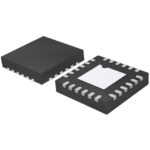 AD5144BCPZ10-RL7
The activity of extra discounts on wholesale prices is in full swing…
Please fill in your contact information and we will send you the latest wholesale price list.





