 ChipApex | Global Electronic Components Supplier
SEARCH
Search Product
Search Post
— IC芯片 | 连接器 | 传感器 | 被动器件 —
Search productSearch post
— IC芯片 | 连接器 | 传感器 | 被动器件 —
Consult the customer manager about the wholesale price.
consultation hotline:86-132-6715-2157
email:[email protected]
Contact the product manager for consultation. One-stop consultation is available.
Do you want a lower wholesale price? Please send us your inquiry and we will reply immediately.
The AD5204BR50 is a quad-channel, 256-position digitally controlled variable resistor from Analog Devices. It features a nominal terminal resistance of 50 kΩ with a temperature coefficient of 700 ppm/°C and a wiper resistance of up to 100 Ω. The device operates on a single supply of +2.7 V to +5.5 V or dual supplies of ±2.3 V to ±2.7 V. It utilizes a 3-wire SPI-compatible serial interface for programming. Each channel includes an independent latch holding the resistance value, which is volatile. The part supports daisy-chaining via an SDO pin and offers power-on midscale preset functionality.
Verify the specific package variant required, as the AD5204 family is available in 24-lead SOIC, TSSOP, and 32-lead LFCSP packages. Confirm that the system design accounts for the volatile nature of the RDAC latches, requiring reprogramming after power cycles unless external retention logic is used. Ensure ESD precautions are followed during handling due to the sensitivity of the CMOS input structures.
Select this component when a multi-channel digital solution is needed to replace mechanical pots. The 50 kΩ value balances noise performance and current handling capabilities compared to 10 kΩ or 100 kΩ variants. Consider the thermal resistance characteristics if operating near the upper temperature limit of +85°C. Verify that the host microcontroller can provide the necessary clock speeds and voltage levels compatible with the 3-wire serial interface.
The AD5204BR50 belongs to the AD5204/AD5206 family of digital potentiometers. While the AD5204 provides four channels, the AD5206 extends this to six channels within similar electrical specifications. Both devices share the same control interface and operational principles, differing primarily in pin count and channel density. This family serves as a direct electronic alternative to traditional mechanical potentiometers in space-constrained PCB designs.
Direct functional equivalents include other quad-channel digital potentiometers from Analog Devices such as the AD8403 series, though interface protocols may differ. For simple rheostat applications, verify that the replacement supports the required 50 kΩ resistance and 256-position resolution. Note that some alternatives may offer non-volatile memory, eliminating the need for post-power-up initialization routines.
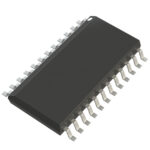 AD5204BR50
The activity of extra discounts on wholesale prices is in full swing…
Please fill in your contact information and we will send you the latest wholesale price list.





