 ChipApex | Global Electronic Components Supplier
SEARCH
Search Product
Search Post
— IC芯片 | 连接器 | 传感器 | 被动器件 —
Search productSearch post
— IC芯片 | 连接器 | 传感器 | 被动器件 —
Consult the customer manager about the wholesale price.
consultation hotline:86-132-6715-2157
email:[email protected]
Contact the product manager for consultation. One-stop consultation is available.
Do you want a lower wholesale price? Please send us your inquiry and we will reply immediately.
The AD5207BRU50 is a dual-channel, 8-bit digital potentiometer with 256 tap positions and a nominal resistance of 50 kΩ. It operates on a single supply from 2.7 V to 5.5 V or a dual supply of ±2.2 V to ±2.7 V. The device features a 3-wire SPI-compatible serial interface for data input and includes a power-down mode consuming less than 5 µA. Key electrical parameters include a wiper resistance of 100 Ω maximum, a temperature coefficient of 500 ppm/°C, and a –3 dB bandwidth of 125 kHz at the 50 kΩ setting. It is housed in a TSSOP-14 package.
Verify the specific ordering suffix (e.g., REEL7) against the required packaging format, as tube and reel options exist within the family. Confirm that the BRU variant meets the necessary industrial temperature range requirements (-40°C to +125°C). Ensure ESD precautions are observed during handling due to the sensitivity of the CMOS inputs. Cross-reference the pinout with legacy components like the AD8402 if drop-in replacement is intended.
Select this component when a dual-channel solution is required within a single TSSOP-14 footprint. The 50 kΩ value offers a balance between noise performance and drive capability compared to 10 kΩ or 100 kΩ variants. Consider the volatile memory type; if non-volatile storage is needed, alternative models such as the AD5231 should be evaluated. Verify that the system logic levels are compatible with the 3-wire serial interface requirements.
This part belongs to the AD5207 series of 256-position digital potentiometers manufactured by Analog Devices. It serves as an electronic alternative to mechanical pots, offering improved reliability and smaller form factors. The 'BRU' designation indicates the industrial temperature grade and the thin TSSOP-14 package style suitable for PCMCIA and portable applications.
The datasheet notes compatibility with the AD8402 for drop-in replacement purposes due to identical address bit structures. Designers replacing mechanical potentiometers should account for the finite wiper resistance (approx. 100 Ω max) which prevents true zero-scale resistance.
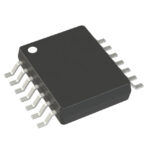 AD5207BRU50
The activity of extra discounts on wholesale prices is in full swing…
Please fill in your contact information and we will send you the latest wholesale price list.




