 ChipApex | Global Electronic Components Supplier
SEARCH
Search Product
Search Post
— IC芯片 | 连接器 | 传感器 | 被动器件 —
Search productSearch post
— IC芯片 | 连接器 | 传感器 | 被动器件 —
Consult the customer manager about the wholesale price.
consultation hotline:86-132-6715-2157
email:[email protected]
Contact the product manager for consultation. One-stop consultation is available.
Do you want a lower wholesale price? Please send us your inquiry and we will reply immediately.
The AD5220BRMZ50-RL7 is a single-channel, 7-bit digitally controlled variable resistor (RDAC) from Analog Devices. It features a nominal resistance of 50 kΩ with 128 tap positions and linear taper. The device utilizes a simple three-wire serial interface consisting of Chip Select (CS), Clock (CLK), and Up/Down (U/D) control lines to adjust the wiper position. Operating on a supply voltage range of 2.7 V to 5.5 V, it draws a typical supply current of 15 µA. The component is housed in an 8-lead Mini Small Outline Package (MSOP) and supports operation across a temperature range of -40°C to +85°C.
Verify the specific ordering suffix RL7 corresponds to the reel packaging format required for automated assembly processes. Confirm that the BRMZ designation matches the MSOP-8 package option needed for the target PCB footprint. Ensure the 'Z' suffix indicates RoHS compliance if environmental regulations apply to the manufacturing site. Cross-reference the 50 kΩ resistance value against circuit requirements to ensure compatibility with load impedance constraints.
Select this model when a single-channel variable resistor with 7-bit precision is required. The 50 kΩ nominal resistance offers a balance between bandwidth and power dissipation compared to 10 kΩ or 100 kΩ variants. The MSOP-8 package is suitable for space-constrained designs. Consider the volatile memory nature of the wiper position, which resets to mid-scale upon power-up, if state retention is critical for system initialization.
This component belongs to the AD5220 family of single-channel digital potentiometers. The BRMZ50 variant specifically denotes the 50 kΩ resistance value within the MSOP-8 package. Other variants in the series include 10 kΩ and 100 kΩ options, as well as different package types such as PDIP and SOIC. The family shares the same 7-bit architecture and three-wire control interface logic.
Direct pin-compatible replacements within the same family include AD5220BRMZ10 (10 kΩ) and AD5220BRMZ100 (100 kΩ). Verify that the alternative resistance value meets the circuit's electrical requirements. For non-pin-compatible needs, consider higher-resolution models like the AD5243, though interface protocols may differ.
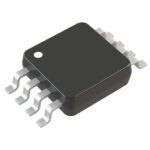 AD5220BRMZ50-RL7
The activity of extra discounts on wholesale prices is in full swing…
Please fill in your contact information and we will send you the latest wholesale price list.





