 ChipApex | Global Electronic Components Supplier

SEARCH
Search Product
Search Post
Search productSearch post
Consult the customer manager about the wholesale price.
consultation hotline:86-132-6715-2157
email:[email protected]
Contact the product manager for consultation. One-stop consultation is available.
Do you want a lower wholesale price? Please send us your inquiry and we will reply immediately.
AD5251BRU10 is listed in the Digital Potentiometers range at ChipApex. The manufacturer field lists Analog Devices Inc. Its product description is IC DGTL POT 10KOHM 64TAP 14TSSOP. Review the specifications below when checking this part for your BOM.
The AD5251BRU10 is a dual-channel, I2C-compatible digital potentiometer featuring nonvolatile memory (EEMEM) for wiper setting retention. It provides 64-position resolution with a nominal resistance of 10 kΩ per channel. The device operates on a single supply voltage ranging from 2.7 V to 5.5 V or a dual supply of ±2.25 V to ±2.75 V. Key electrical characteristics include a typical power-on refresh time of 300 µs and an EEMEM rewrite time of 540 µs. It supports direct read/write access to RDAC and EEMEM registers, allowing for precise calibration and system identification data storage within the 12 extra bytes of user-defined memory.
Verify the specific suffix 'RU10' against the manufacturer's current ordering guide to confirm package type and temperature grade. Confirm RoHS compliance status as specifications may vary by manufacturing lot. Ensure I2C pull-up resistors are correctly sized for the operating voltage and bus speed requirements before integration.
Select this component when dual-channel digital adjustment with nonvolatile storage is required. The 10 kΩ value suits moderate impedance applications; verify input leakage currents if interfacing with high-impedance sensors. Ensure the host controller supports the standard I2C protocol and can handle the 400 kHz clock frequency specified for optimal performance.
This part belongs to the AD5251/AD5252 family of digitally controlled potentiometers. While the AD5252 offers 256 positions and multiple resistance values, the AD5251 variant is limited to 64 positions. The 'BRU' designation typically indicates a commercial temperature range and TSSOP-14 packaging, distinguishing it from industrial or automotive qualified variants.
Direct pin-to-pin replacements within the same family include other AD5251 variants with different resistance values (e.g., AD5251BRU50 for 50 kΩ). Cross-family replacements require verification of I2C address compatibility and register mapping. Ensure substitute parts support the same nonvolatile memory functionality if power-on state retention is critical.
The AD5251 automatically restores the last stored wiper position from the EEMEM to the RDAC registers upon power-up, typically within 300 µs.
The device supports an SCL clock frequency of up to 400 kHz, adhering to the Fast Mode I2C specification.
Yes, the device features a patented function that allows storing the absolute end-to-end resistance tolerance in the nonvolatile memory for precision applications.
Explore related parts through Data Acquisition, Integrated Circuits (ICs), all product categories, ChipApex homepage.
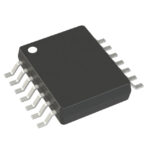 AD5251BRU10

The activity of extra discounts on wholesale prices is in full swing…
Please fill in your contact information and we will send you the latest wholesale price list.





