 ChipApex | Global Electronic Components Supplier
SEARCH
Search Product
Search Post
— IC芯片 | 连接器 | 传感器 | 被动器件 —
Search productSearch post
— IC芯片 | 连接器 | 传感器 | 被动器件 —
Consult the customer manager about the wholesale price.
consultation hotline:86-132-6715-2157
email:[email protected]
Contact the product manager for consultation. One-stop consultation is available.
Do you want a lower wholesale price? Please send us your inquiry and we will reply immediately.
The AD5662ARJ-2REEL7 is a single-channel, 16-bit digital-to-analog converter (DAC) from Analog Devices' nanoDAC family. It operates on a single supply voltage ranging from 2.7 V to 5.5 V and features a rail-to-rail buffered output amplifier. The device guarantees 12-bit accuracy and is monotonic by design. Key electrical parameters include a maximum settling time of 10 μs, a typical power consumption of 250 μA at 5 V, and a power-down current as low as 100 nA at 3 V. It utilizes a versatile 3-wire serial interface compatible with SPI, QSPI, Microwire, and DSP standards, supporting clock rates up to 30 MHz.
Verify the ordering suffix '-2' confirms the power-on reset behavior targets midscale upon startup. Confirm the package type matches the SOT-23-8 form factor specified for this variant. Ensure the reel packaging quantity aligns with production requirements. Check RoHS compliance status against current regulatory standards before finalizing procurement orders.
Select this component when a single-channel, high-resolution DAC with rail-to-rail output is required in a compact SOT-23 package. The external reference input necessitates pairing with a precision voltage reference IC for optimal accuracy. Consider the 10 μs settling time for bandwidth limitations in dynamic applications. Evaluate the 3-wire interface compatibility with the host microcontroller's available serial ports.
This part belongs to the AD5662 nanoDAC family, which offers various configurations including different resolutions and package types. The 'ARJ' designation indicates the specific SOT-23-8 package variant, while the '-2' suffix defines the power-on reset state. Related devices in the series include the AD5660 and AD5663, offering alternative pinouts or channel counts within the same architectural framework.
Direct replacements must maintain the 16-bit resolution, SOT-23-8 package, and midscale power-on reset feature. Verify that any substitute supports the same 2.7 V to 5.5 V supply range and 3-wire serial interface timing specifications. Ensure thermal impedance and power dissipation characteristics are comparable for the target application environment.
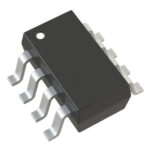 AD5662ARJ-2REEL7
The activity of extra discounts on wholesale prices is in full swing…
Please fill in your contact information and we will send you the latest wholesale price list.






