 ChipApex | Global Electronic Components Supplier
SEARCH
Search Product
Search Post
— IC芯片 | 连接器 | 传感器 | 被动器件 —
Search productSearch post
— IC芯片 | 连接器 | 传感器 | 被动器件 —
Consult the customer manager about the wholesale price.
consultation hotline:86-132-6715-2157
email:[email protected]
Contact the product manager for consultation. One-stop consultation is available.
Do you want a lower wholesale price? Please send us your inquiry and we will reply immediately.
The AD5663BRMZ is a dual 16-bit buffered voltage-output digital-to-analog converter (DAC) from the nanoDAC family. It operates on a single 2.7 V to 5.5 V supply and features rail-to-rail output swing. The device guarantees monotonicity by design with a maximum relative accuracy of ±12 LSBs for the B grade. Power consumption is typically 1.25 mW at 5 V, dropping to 480 nA in power-down mode. It utilizes a versatile 3-wire serial interface supporting clock rates up to 50 MHz, compatible with SPI, QSPI, Microwire, and DSP standards. Key features include hardware LDAC and CLR functions, per-channel power-down, and an internal power-on reset circuit.
Verify the specific grade (B Grade) and package type (10-lead MSOP) against project requirements. Confirm that an external reference voltage is available, as the AD5663BRMZ does not include an internal reference. Ensure the system logic levels are compatible with the specified VINL and VINH thresholds for reliable serial communication.
Select this component when dual-channel precision is required in a compact surface-mount package. The B grade offers ±12 LSBs accuracy suitable for general instrumentation. Consider the AD5663BRMZ-1 variant if a midscale power-up state is preferred over the standard zero-scale reset. Verify capacitive load stability requirements, as the device supports up to 10 nF with a 2 kΩ load.
The AD5663BRMZ belongs to Analog Devices' nanoDAC family, designed for low-power applications. It shares architectural similarities with the AD5623R and AD5643R but provides higher 16-bit resolution. The BRMZ suffix indicates the B grade performance level and the 10-lead MSOP packaging option, distinguishing it from LFCSP_WD variants or other accuracy grades within the same series.
Direct functional replacements within the same package and pinout include the AD5663ARMZ (A grade, ±8 LSBs accuracy). For single-channel applications, the AD5662 series may be considered, though pinouts differ. Cross-family substitutes like the AD5693 offer I2C interfaces but require schematic adjustments.
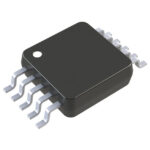 AD5663BRMZ
The activity of extra discounts on wholesale prices is in full swing…
Please fill in your contact information and we will send you the latest wholesale price list.






